avg —
Caesar Salad Dressing at Home (+Cooking Video)

Instructions
Get all the necessary ingredients ready. Since the eggs will be used semi-raw, I recommend choosing a producer you trust.
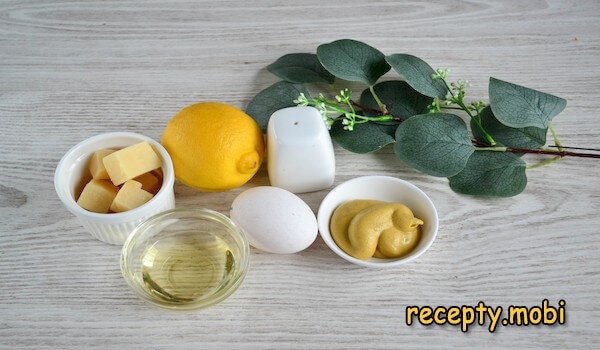
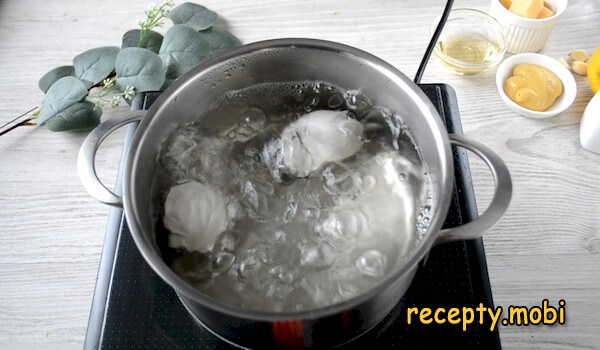
Lower the eggs into boiling water for literally 1.5–2 minutes, then take them out and transfer them to cold water. In this short time the eggs will get only minimal heat treatment – when I crack them, the white has whitened a little but is still quite liquid, and that is exactly how it should be.
Grate the Parmesan on a fine grater.

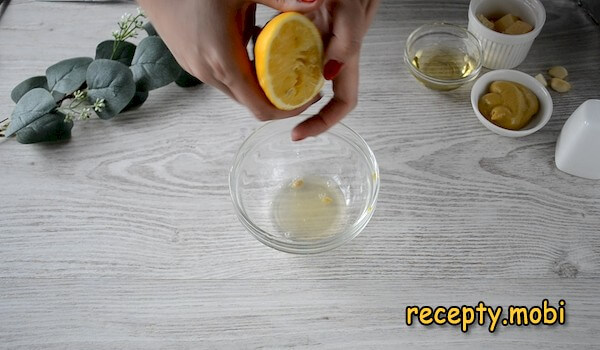
Squeeze the juice from half a lemon and strain it through a sieve, so that no seeds end up in the sauce.
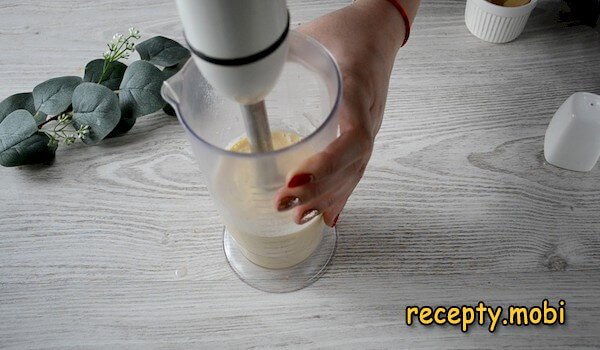
Into the blending beaker, break the eggs, add the mustard, lemon juice and Parmesan, squeeze in a clove of garlic, season with salt and pepper to taste, and pour in the olive oil. Blend at maximum speed with an immersion blender until smooth and uniform.
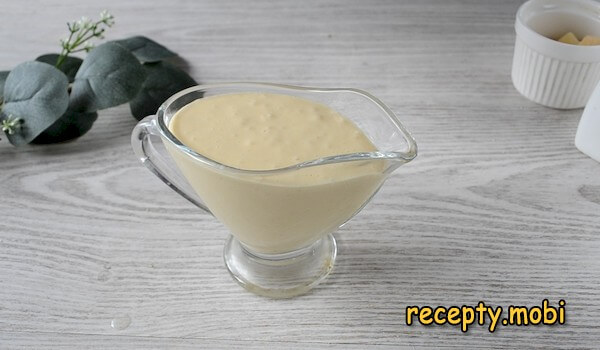
Then taste the sauce and, if needed, add a little more salt or pepper, or squeeze in another clove of garlic. The homemade Caesar salad dressing should turn out perfect – then the salad itself will be very tasty too.Bon appétit!


Tips
- 1
Soft-boiled eggs (1.5–2 minutes) are the key step. Raw eggs carry a salmonella risk, while fully boiled eggs make the dressing curdle into lumps. Only semi-raw eggs give a proper emulsion.
- 2
An immersion blender at maximum speed emulsifies the sauce correctly. Whisking by hand with a whisk will make it separate within an hour.
- 3
Strain the lemon through a sieve so there are no seeds. A single seed will spoil the whole sauce, turning it bitter when blended.
- 4
Taste and adjust to your own preference. Use 2–3 cloves of garlic and 1–2 teaspoons of mustard. The same principle works for other homemade salad dressings.
Video
FAQ
Which eggs are safe to use? +
Only fresh eggs from a trusted producer – the salmonella risk is real. Look for brands with quality control, such as Okskoye, Roskar Poultry Farm, Sinyavinskaya or Yaroslavsky. Check freshness by lowering an egg into cold water: a fresh one sinks, an old one floats. Quail eggs (4–5 instead of 2 chicken eggs) are the safest option, as they do not carry salmonella. Shop eggs marked "D" (dietary, up to 7 days old) are ideal. To be extra safe, use pasteurised eggs. Do not use cracked eggs or ones with a dirty shell. Rinse them under warm water before boiling. They are not recommended for pregnant women, children under 5 or the elderly (only fully boiled eggs for them). For a "safe" version, boil the eggs for 5 minutes (the sauce will be thicker).
What can replace Parmesan? +
Alternatives include Grana Padano (Italian, similar), Pecorino Romano (salty, rich), Džiugas (Lithuanian) and Russian hard cheese. Good-quality brands include Brest-Litovsk, Staroselsky and Carmen. Not suitable: processed cheese, brined cheeses (mozzarella, feta) and string cheese. For a "premium" version, use Parmesan aged 24 months. Grate it finely for the sauce – it emulsifies faster; grate it coarsely for sprinkling over the finished salad. Young Parmesan (12 months) also works. Fresh cheese has no cracks, a yellowish colour and a firm texture. A fat content of 30% is optimal for the sauce. Do not use pre-grated "Parmesan in bags" – it is dry and tasteless.
How long does the sauce keep? +
In the fridge in a glass jar with a lid – 24 hours. Any longer and the eggs curdle, the sauce separates and loses its flavour. Freezing is not recommended (the sauce splits). Before using, shake it (not with a mixer) to mix in what has settled. Take it out 5–10 minutes before serving (it tastes better at room temperature). Do not leave it at room temperature for longer than 2 hours, as the eggs spoil. For a party, make it at most 1–2 hours before serving. It is not suitable for freezing into serving cubes, as the sauce is too fatty. From 200 ml you get about 3 servings for salad (50–60 ml each).
What dishes does it go with? +
Classic pairings: Caesar salad with chicken, prawns or turkey. With baked or fried vegetables it is unusual. With roast beef and salad leaves. On chicken sandwiches it works as a dressing for burgers. With croutons and bacon it makes a "fitness breakfast". With grilled tuna or salmon. Do not use it with stewed fish (it overpowers the flavour) or with light vegetable soups (too fatty for them). With chicken pasta it is an unusual combination. With chicken-and-tomato pizza it gives an "Italian-American" version. It is a versatile sauce for dishes with chicken and crisp leaves.
- Comment
or post as a guest
Be the first to comment.