avg —
Mozzarella Cheese at Home from Cow's Milk

Instructions
I prepare good-quality milk – a critical choice for successful mozzarella. I use ONLY whole farm cow's milk (2 l), ideally from a farmer you know. The milk should be "mature" (left to stand in the fridge for 2–3 days), unpasteurised, with a high fat content of 3.5–4%. Freshly milked milk is not suitable – it has not had time to "mature". Shop-bought pasteurised and ultra-pasteurised milk is categorically a NO; it will give curd flakes rather than cheese threads.
Two to three hours before cooking, I take the milk out of the fridge so that it warms up to room temperature. Cold milk straight from the fridge needs prolonged heating, which can change the structure of the proteins. Warm room-temperature milk is the best start for cheese-making.
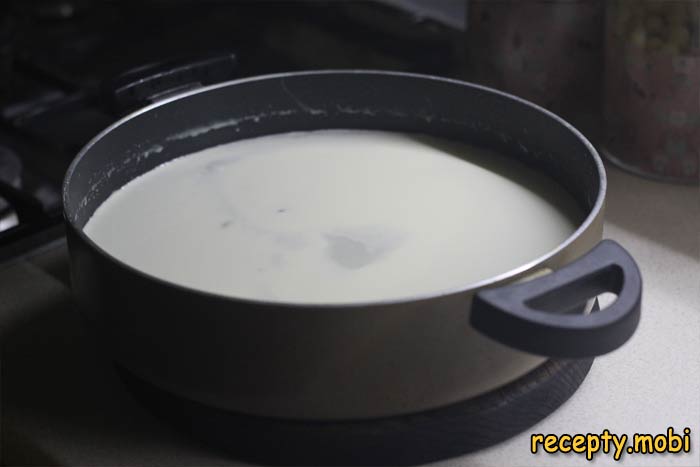
I pour the milk into a large thick-bottomed pot or saucepan (3–4 l capacity). A thick base distributes the heat evenly – a thin one will scorch the milk at the edges. Stainless steel or a ceramic coating is ideal. Aluminium and copper pans are not suitable – they can react with the vinegar and change the taste of the cheese.
I put the pot on medium heat and warm the milk, stirring occasionally with a silicone spatula. There is NO need to bring it to the boil. The aim is to heat it to a temperature of 70–75°C (hot, but not boiling). A simple way to check: dip a clean finger into the milk – it should be hot but bearable, and you should be able to hold your finger in for 5 seconds. If your finger gets "burnt", the milk is too hot, so let it cool down.
I take the saucepan of hot milk off the heat. CRITICAL STEP: I add the 9% table vinegar (6 tbsp) GRADUALLY, one tablespoon at a time, stirring thoroughly after each one with a silicone spatula. Do NOT pour the vinegar in all at once – the reaction needs to happen gradually to form the right cheese structure.
After just 2–3 tablespoons of vinegar you will see the magic: threads of cheese begin to form on the surface of the milk, and the whey starts to separate (turning a clear yellow). Keep adding vinegar up to 5–6 tablespoons depending on the milk – until all the whey has turned yellow and the cheese gathers into a dense lump.
Once the cheese has formed into a lump, I carefully lift it out of the saucepan with a slotted spoon and transfer it to a sieve or fine-mesh colander. I thoroughly squeeze out the excess liquid by hand – the cheese should "hold its shape" and be firm. Do not squeeze too hard – you need to keep the elasticity for the next stage.
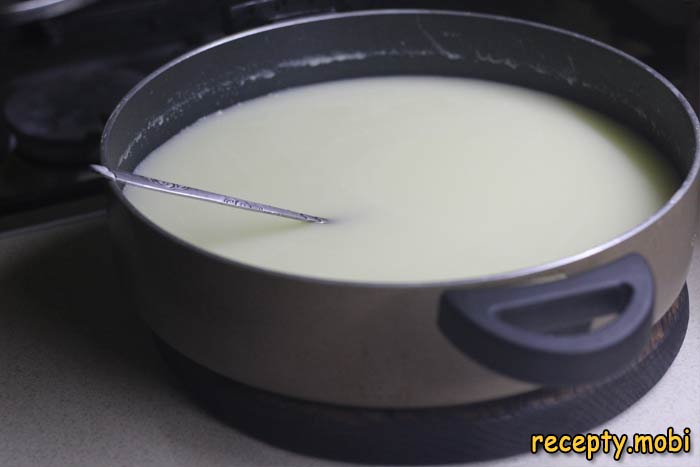
I do NOT pour away the whey (left in the saucepan) – it is needed for the final treatment of the cheese. I return the whey to the heat, add the rock salt (½ tbsp) and stir thoroughly until it dissolves. I heat the whey until the first steam appears (70–75°C) – hot whey is needed to "pull" the cheese into a stretchy structure.
I lower the cheese ball into the hot salted whey. At first the cheese will be a bit firm – this is normal. Using a silicone spatula or a spoon, I gently dip the cheese into the hot whey, lift it out and lower it again. You can also spoon the whey over the cheese from above. The cheese will start to soften and become elastic.
Once the cheese has become soft and elastic, I start to stretch it by hand (use kitchen gloves or dip your hands in cold water – the whey is hot!). I pull the cheese upwards like "chewing gum", fold it and pull again. I repeat this 5–7 times until the structure becomes uniform and "stretchy" like factory-made mozzarella.
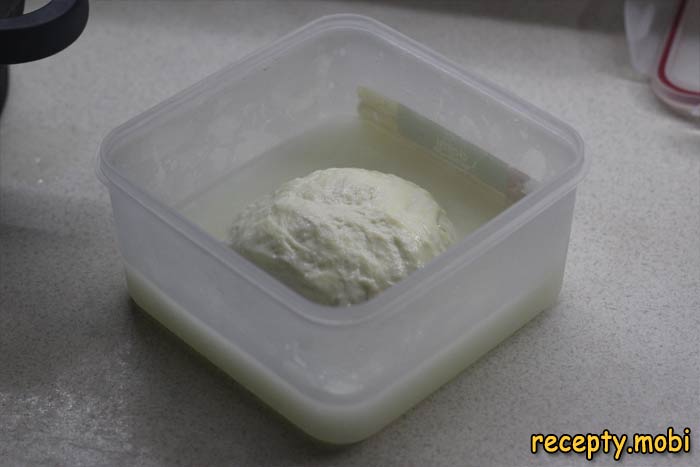
Once the desired "stretchy" structure is reached, I gather the cheese into a dense ball, wrapping the sheet of cheese around my hand. You can make one large ball (for slicing into pieces) or several small balls (bocconcini-style, for salads). Adjust the size as you like.
I immediately lower the finished mozzarella balls into ice-cold water (1 l + 5–6 ice cubes) for 10 minutes – this "cold shock" sets the structure and shape of the cheese. Without this step the balls will "lose" their shape as they cool. The homemade Mozzarella cheese is ready!
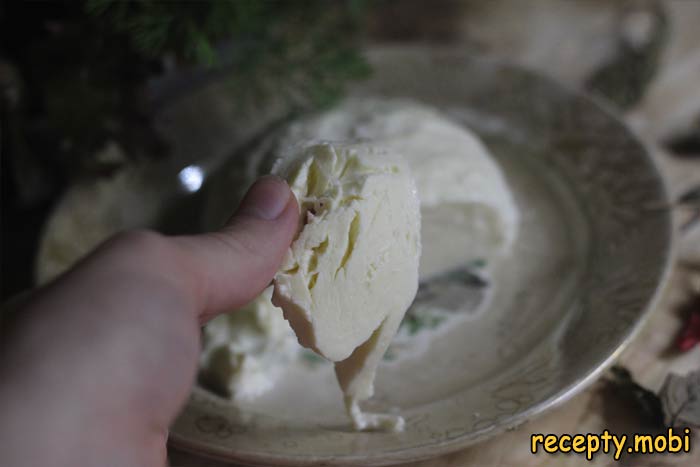
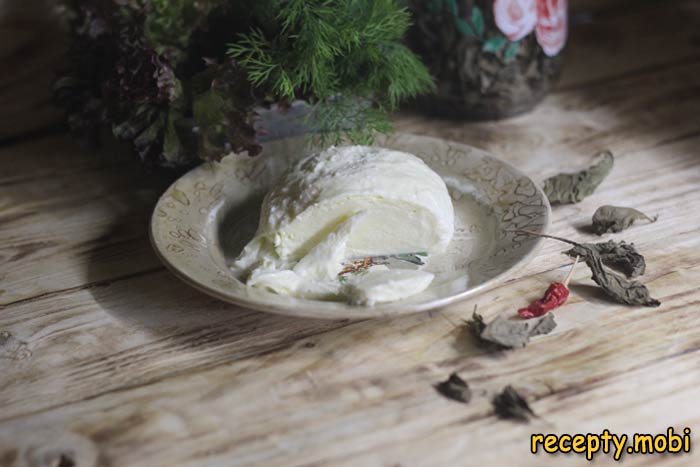
I store the finished mozzarella in salted whey (½ tsp salt per 1 cup of whey), diluted with water 1:1, in a glass jar in the fridge for up to 5 days. Before serving I cut it into 5–7 mm slices or into balls. It is ideal for a Caprese salad with tomatoes and basil, for pizza, lasagne and sandwiches.


Tips
- 1
Use ONLY whole unpasteurised farm milk at 3.5–4% fat – shop-bought milk will give curds instead of cheese threads.
- 2
Add the vinegar GRADUALLY, one tablespoon at a time – adding it all at once will ruin the cheese structure.
- 3
Do not throw away the whey – hot salted whey is needed to stretch the cheese into threads. I use a similar principle to make Fetaxa cheese at home.
- 4
Use kitchen gloves or dip your hands in cold water while stretching – the whey is very hot and you can get burnt.
FAQ
What can I use instead of vinegar to curdle the milk? +
Suitable alternatives are: citric acid (dissolve ½ tsp in 100 ml of water and add it gradually – it gives a more "neutral" taste), fresh lemon juice (5–6 tbsp), 6% apple cider vinegar (a more "farmhouse" character), white wine vinegar (for Italian authenticity), rennet (½ a tablet for the classic mozzarella technique – it gives a better stretchy structure), or liquid pepsin (follow the manufacturer's instructions). Table vinegar is the most accessible "household" option, while citric acid is "neutral" in taste. Rennet is the "proper" Italian option and is sold in specialist shops for cheese-makers.
Can I use goat's milk instead of cow's milk? +
Yes, goat's milk works very well for homemade mozzarella. The structure is slightly different – the cheese turns out more "tender" and with a characteristic "goaty" aroma. Use unpasteurised whole goat's milk with a high fat content (3–4%) as well. The cooking time and technique are identical to the cow's milk recipe. You can also make it from sheep's milk (a rarer product) – it will give a richer, more nourishing cheese. "Real" Italian mozzarella di Bufala is made from buffalo milk – the most expensive and authentic option. Each type of milk gives the cheese its own character.
How long does homemade mozzarella keep? +
Fresh homemade mozzarella keeps in the fridge for up to 5 days in salted whey (½ tsp salt per cup of whey + an equal amount of water) in a glass jar. Change the "brine" every day to keep it fresh. If you have no whey, store it in salted water. Mozzarella left open without whey dries out within 1–2 days. Do not freeze it – the structure of the "stretchy" threads will break down on thawing and the cheese will become crumbly. Fresh mozzarella is best eaten on the day it is made or the next day – that is when it is tastiest and most elastic.
What do you serve homemade mozzarella with? +
It is ideal for the classic Italian "Caprese" salad – mozzarella + tomatoes + basil + olive oil + balsamic. On homemade Margherita pizza and other kinds – it melts into the characteristic "stretchy" threads. In lasagne between the layers of pasta with Bolognese and Béchamel sauce. On sandwiches with prosciutto (Italian ham) and rocket. In a Greek salad instead of feta, for a tender touch. In vegetable salads with lemon juice and olive oil. To drink – an Italian dry white wine (Pinot Grigio), a light red (Chianti), or prosecco.
- Comment
or post as a guest
Be the first to comment.