avg —
How to Dye Eggs with Hibiscus Tea

Instructions
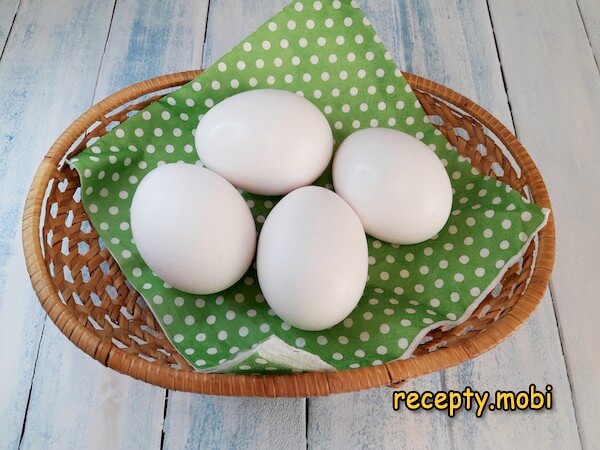
Prepare the ingredients listed above. It is best to take the eggs out of the fridge about 10 minutes ahead so that they come to room temperature – this is one of the ways to stop the shells cracking during boiling.
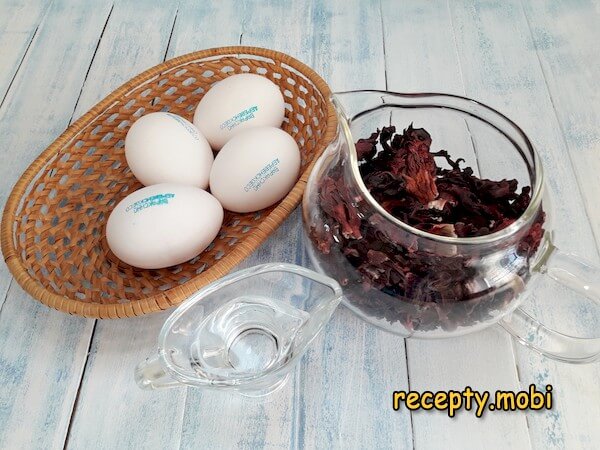
The surface of the eggs must be clean, so wash it with a sponge and a little baking soda. Work gently so you don't damage the shells.
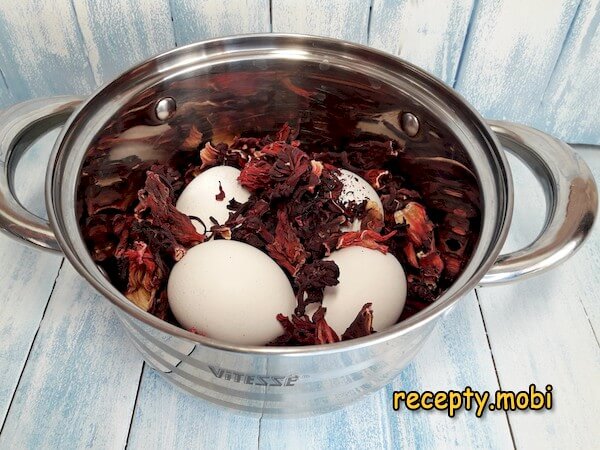
Spread a layer of hibiscus over the bottom of a small pot. Place the eggs on top, then pour the rest of the tea over them.
Pour in enough water to cover everything. Put the pot on the stove and, once it comes to a boil, reduce the heat to its lowest setting. Boil the eggs for 10 minutes.
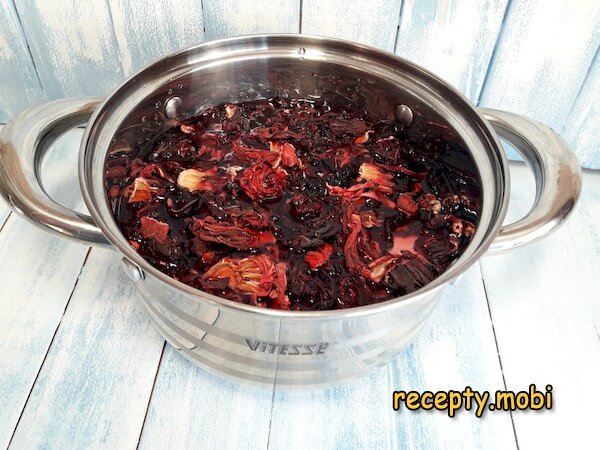
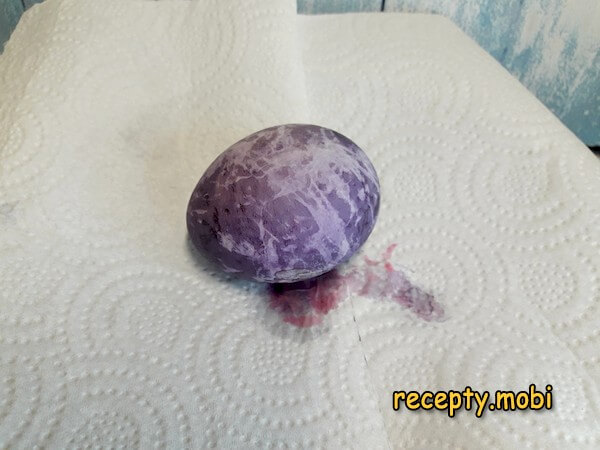
Next, turn off the stove and leave the pot standing with the hot broth for another 10 minutes, then carefully take out the first egg – it will be a pale lilac colour.

Move it onto a napkin. Within a couple of minutes the egg will darken and the purple colour will become more pronounced. After another 10 minutes, take out the second egg – it will be just as purple as the first, but a little brighter. Meanwhile the remaining 2 eggs are still in the hot tea, soaking up its colour.
Add the vinegar to the tea broth, stir, and let the colour develop for 20 minutes.

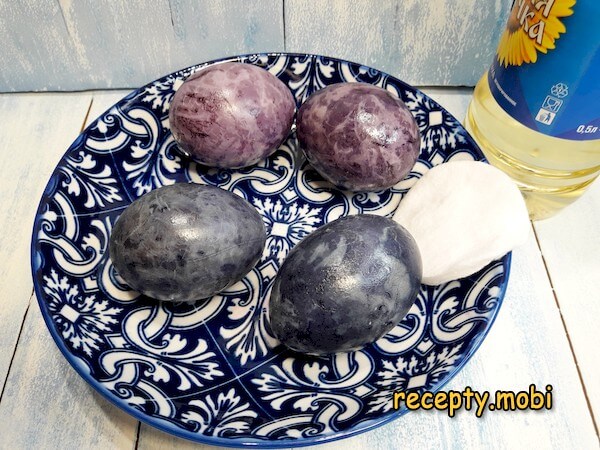
Now you can take out the remaining eggs – they have taken on a deep blue colour, and the colouring, in both the purple and the blue tones, is uneven: it has flecks and streaks that resemble a cosmic pattern. To give the eggs a shine, wipe them with a cotton pad lightly moistened with vegetable oil.Once you know the technique for dyeing eggs with hibiscus tea, you can achieve different shades of blue-purple without using any artificial colourings. Such beauty can be kept in the fridge for a whole week.


Tips
- 1
Take the eggs out of the fridge 10 minutes ahead – the trick against cracks. Cold eggs going into hot water meet a sharp change in temperature that cracks the shell. Warm eggs don't crack.
- 2
Vinegar at the end – the trick for intensity. An acidic environment fixes the blue anthocyanin pigment from the hibiscus. Without vinegar you get purple; with vinegar, a deep blue.
- 3
Take the eggs out one at a time – the trick for a gradient. From 10 minutes of boiling to 30 minutes of steeping, the shades change. You can get a whole palette from a single batch.
- 4
Wipe them with oil – the trick for shine. The shell is matte after boiling. A drop of vegetable oil and the eggs gleam as if lacquered. The same principle works in other kinds of natural dyeing for Easter eggs.
Video
FAQ
Which eggs should I choose? +
Ideally, fresh white eggs (4 pcs) – a neutral shell takes the colour best. Alternatives: farm eggs, though the shell colour will interfere; quail eggs (about 16 to replace 4 chicken eggs) – small, good for decoration; duck eggs (2–3, large); or a mix of chicken and quail for variety. Fresh eggs from the farm are the premium option. Do not use cracked eggs (the dye will get inside), eggs with a dirty shell, or dark-brown eggs (the hibiscus colour will not show). For the classic result, you need fresh white eggs.
What can I use instead of hibiscus tea? +
Alternatives: onion skins (dark brown and ginger tones); turmeric (yellow, 2 tablespoons per litre); beetroot juice (pink to red, 200 ml); spinach juice (green, 200 ml); coffee (beige-brown, 4 tablespoons per litre); blueberries or blackberries (purple, 200 g); chamomile (yellow, 50 g); red cabbage juice (blue, 500 ml); or turmeric with baking soda for green. Loose dried hibiscus petals are the premium choice. Avoid bagged hibiscus blended with other flavourings. For the classic result, you need loose hibiscus petals.
How long do dyed eggs keep? +
In the fridge, in open packaging (for air circulation), up to 1 week. If the eggs were boiled for 10 minutes or more (as in this recipe), 7 days; if less, a shorter time. At room temperature, no more than a day, especially in a warm room. Freezing is not recommended, as the yolk turns rubbery. Don't leave them at room temperature for longer than 4 hours on Easter day. It is best to dye them 1–2 days before Easter.
What goes well with dyed eggs? +
The Easter classic: with Easter cake and curd paskha. With a cup of black tea and lemon. With Cahors (church wine). With fresh herbs (parsley, dill). With salt on the plate, in the Orthodox tradition. With mayonnaise or sour cream, for an egg salad. With a garlic sauce or a meat platter. On the Easter table beside the cakes, or as a handy snack for an Easter picnic. The eggs are the main decoration of the Easter table, and people exchange them with loved ones on Easter Sunday.
- Comment
or post as a guest
Be the first to comment.