avg —
Pickled Herring in Mustard Marinade

Instructions
I choose good-quality herring: it should be firm when pressed, with shiny skin and no yellowish patches (a sign of oxidised fat), with clear eyes and a pleasant sea smell. If I use frozen fish, I thaw it slowly in the fridge for 8–10 hours – quick thawing at room temperature spoils the texture of the flesh.
I rinse the fully thawed herring thoroughly under cold running water. With a sharp knife I cut off the head, make an incision along the belly and carefully remove all the insides. I pay special attention to the black film along the backbone – it tastes bitter if it is not scraped away. I rinse the gutted fish once more.
I cut the fillet off the backbone: I make an incision along the back from head to tail, then carefully separate the flesh from the bones, running the knife along the rib bones. I turn the fish over and repeat on the other side. I get 4 fillets (2 from each fish). With tweezers I pull out the small bones from the centre of the fillet – they are easy to feel with your fingers.
I cut the prepared fillet crosswise into portion-sized pieces about 1.5–2 cm wide. This size is convenient to eat and lets the marinade soak through the fish quickly. Slices that are too thin will fall apart, and ones that are too thick will not marinate through.
I make the mustard marinade: into a deep bowl I put 2 tablespoons of table (hot) mustard and 1 tablespoon of French wholegrain mustard. I add 1–2 tablespoons of runny honey (I adjust the amount to taste – more honey for sweetness, less for sharpness) and 1 tablespoon of coarse salt. I sprinkle in 2 teaspoons of the spice mix: ground coriander, savory, a pinch of nutmeg and black pepper.
I squeeze the juice from half a large lemon (about 30–40 ml) and add it to the marinade. The lemon juice adds freshness and helps to lightly "cook" the fish with its acidity. I mix all the marinade components thoroughly with a whisk or fork until completely smooth – the salt and honey should dissolve.
I peel the onion and cut it into thin half-rings 2–3 mm thick. I rinse the dill, pat it dry and chop it finely. The onion and herbs add aroma and look attractive in the finished dish. I slice the remaining half of the lemon into thin rounds – they will be used for garnish and a little extra tang.
Into a glass or enamelled dish (metal oxidises from the acid) I lay a layer of fish fillet, scatter over some of the onion and dill and pour over a third of the marinade. I repeat the layers until the ingredients run out. The top layer is pieces of fish, generously coated with marinade and decorated with lemon slices.

I gently knead the fish with clean hands so the marinade is distributed evenly between the pieces. I cover the dish with cling film, pressing it against the surface of the fish for better contact. On top I place a small weight (a jar of water, a heavy plate) – under pressure the fish soaks up the marinade better.
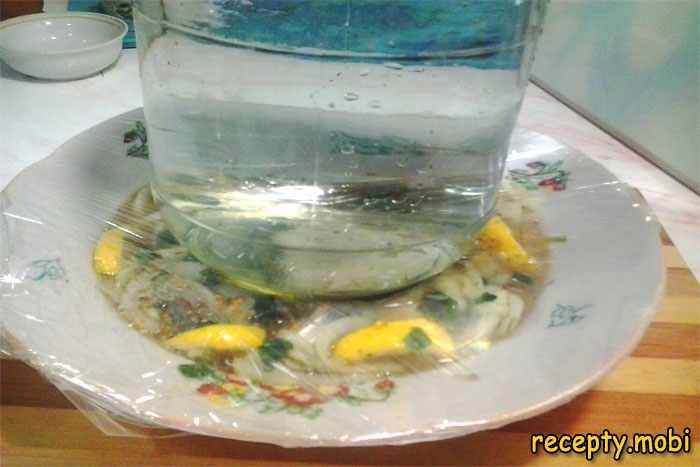
I leave the herring to marinate at room temperature for 4–5 hours. At room temperature the marinating goes faster than in the fridge. The fish quickly soaks up the mustard sauce and becomes piquant, slightly sharp and sweetish at the same time. After marinating, I move it to the fridge – there the herring will reach perfection.
For the festive evening, or the next day, I take the finished marinated herring out of the fridge. I arrange it on an attractive dish and garnish it with fresh dill and onion rings from the marinade. I serve it as an appetiser on its own or with boiled potatoes – a classic combination!



FAQ
Can I use ready-salted fillet? +
Yes, this will speed up the process. Halve the amount of salt in the marinade or leave it out entirely – the ready fillet is already salted. Reduce the marinating time to 2–3 hours.
What can replace French wholegrain mustard? +
If you have no wholegrain mustard, increase the amount of ordinary table mustard by 1 tablespoon. The marinade will have a smoother texture, without the characteristic grains, but the flavour will still be interesting.
Why did the fish turn out too salty? +
You may have left it in the marinade too long or added too much salt. Next time, reduce the amount of salt or shorten the marinating time. Over-salted fish can be soaked in cold water for 30 minutes.
Can I marinate mackerel using this recipe? +
Yes, mackerel is excellent for a mustard marinade. The method is the same, and the marinating time can be increased to 6–8 hours – mackerel is denser than herring.
Is the recipe suitable for lightly salted fish? +
For a lightly salted version, reduce the salt to 1.5 teaspoons and the marinating time to 3 hours. The fish will be more delicate, but it can only be kept for 2–3 days.
- Comment
or post as a guest
Be the first to comment.