avg —
Radish and Carrot Salad

Instructions
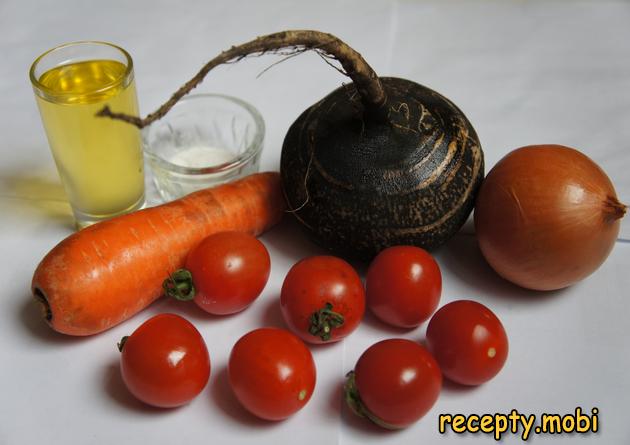
Prepare the ingredients on the work surface. The main ones are radish, carrot, onion, tomatoes and olive oil. Choose firm, fresh vegetables with no spots or bruises. The radish should be dense, with no sprouted shoots inside (they make it bitter).
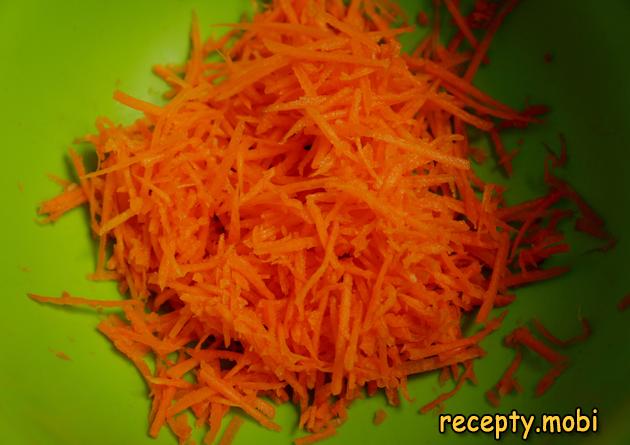
Prepare the sweet carrot. Choose a bright, juicy, large carrot – a stocky one is better than a long one for grating. Wash the carrot thoroughly under running water. With a thin vegetable knife, peel off the skin – not too thickly, or you will lose the sweetest, most vitamin-rich layer just under the skin. Rinse the peeled carrot again with clean water and pat it dry with a paper towel. Grate it on the coarse side of a box grater – this gives the characteristic orange shreds in the finished salad. Alternatively, use a Korean-style grater for finer, longer strands.
Prepare the black radish (250 g, 1 pc) – the BASE of the salad, with its characteristic earthy taste. Wash the radish thoroughly under a stream of water. With a sharp knife, peel off the skin in a thin layer, not deeply. Cut the peeled root into thin slices 2–3 mm thick – almost translucent slices.
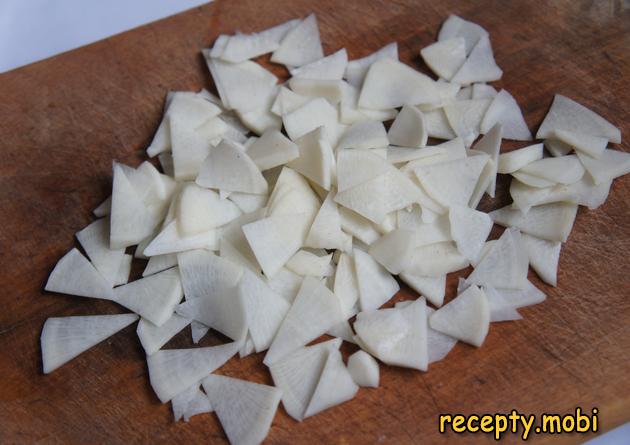
CRITICAL STEP: cover the radish slices with cool clean water and leave them for 30 MINUTES. This is the secret step for removing the bitterness and sharp bite from black radish. Without soaking, the salad can turn out too sharp and bitter. If you are using DAIKON or WATERMELON radish, soaking is NOT needed – these varieties are mild to begin with, with no pronounced sharpness, and can be used directly in the salad after slicing.
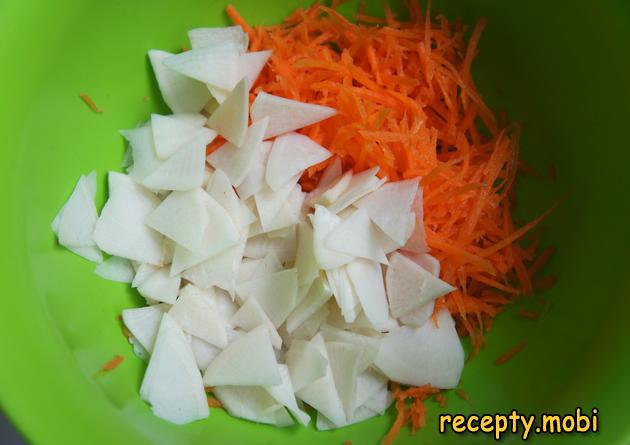
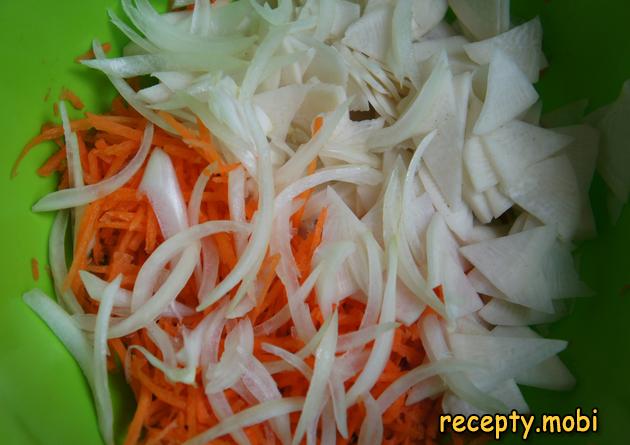
After 30 minutes, take the radish slices out of the water and put them in a sieve or colander to let the drops of water drain off – damp slices would water the salad down. Let the water drain for 5–10 minutes. Transfer the drained radish slices to a large salad bowl with the grated carrot. Mix gently with a silicone spatula so the carrot and radish are evenly distributed.
Peel the onion (1 pc). Slice it into thin feathers – thin half-rings 1–2 mm thick. If you like, to reduce the sharpness, pour boiling water over the chopped onion for a few minutes, then lift the onion out of the water with a sieve – the hot water tames the harsh bite while keeping the onion aroma. Remove any remaining moisture by placing the scalded onion slices in a sieve for 5 minutes.
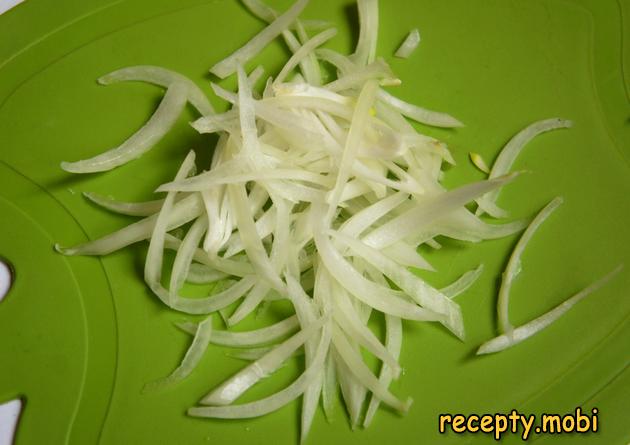
Tip the drained onion feathers into the salad bowl with the radish and carrot. Mix all the ingredients in the bowl, adding salt (½ tsp, to taste) and vegetable oil (5 tbsp). Use extra virgin olive oil for a gourmet version, or unrefined sunflower oil for a bright traditional aroma. If you like, add 1 tsp of fresh lemon juice for a fresh citrus note. Mix the salad thoroughly so the vegetables are evenly coated with oil and salt. Let it stand for 5–7 minutes at room temperature – the flavours will come together and the vegetables will soften slightly.
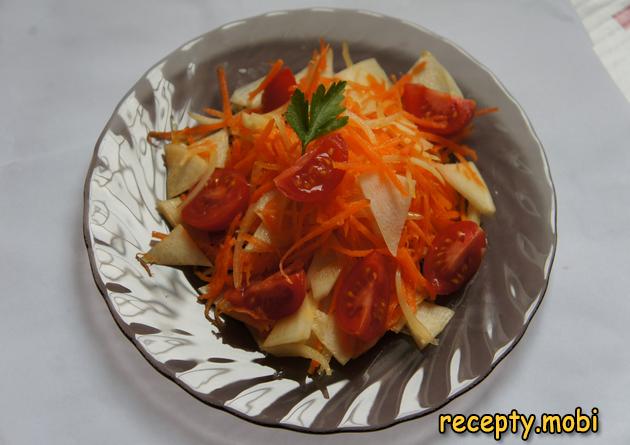
The radish and carrot salad should be served IMMEDIATELY after it is made, because the cut vegetables tend to release moisture quickly – after 30–60 minutes a lot of liquid appears in the salad. Transfer the finished salad to a serving plate. Prepare the tomatoes for an attractive presentation: choose small fruits – CHERRY TOMATOES are ideal (7 pcs). Wash and pat them dry with a paper towel, then cut each cherry tomato in half or into 4 pieces depending on size – you will get 14–28 bright pieces to decorate the salad. Arrange them evenly on top of the salad. Wash ½ bunch of dill and parsley, chop finely and scatter generously over the salad for a green garnish and fresh aroma. The radish and carrot salad is ready! Serve it as an appetiser or as a side with a main dish.


Tips
- 1
ALWAYS soak black radish for 30 minutes – the secret to removing bitterness and the sharp bite.
- 2
Scald the onion with boiling water for 1 minute – the secret to reducing sharpness without losing aroma.
- 3
Serve the salad IMMEDIATELY after making it – the vegetables quickly release liquid. I make Korean-style carrot on a similar principle.
- 4
Use CHERRY tomatoes to serve – small fruits look nicer than large chunks in the salad.
FAQ
Which variety of radish is best for the salad? +
Different varieties suit, depending on the flavour you want. Black radish (round winter radish) is the classic Russian choice with its characteristic sharp taste; it needs 30 minutes of soaking to remove the bitterness. Daikon (long white radish) is a mild Japanese radish with no sharp bite; it does not need soaking and has a delicate, slightly sweet taste. Green radish (Margelan) is a Central Asian variety with a light sharpness and does not need soaking. Watermelon radish has unusual pink flesh with a white skin and a very mild taste. Red radish is small and suits salads with ordinary chopped vegetables. Black radish is the classic of the Russian salad, while daikon is the modern, mild option.
What can I use instead of black radish? +
Good options are: daikon (a milder Japanese radish, with no sharp bite), Margelan green radish (a mild Central Asian variety), young turnip (a delicate, slightly sweet country flavour), swede (an old Russian vegetable), parsnip (a more European option), celeriac (for a diet-friendly version) and young spring radishes (a brighter colour and milder taste). Black radish is the Russian classic, with its characteristic sharp taste and dark purple-black skin. Daikon is the most convenient substitute, as it does not need soaking. Each vegetable gives its own character – experiment with the season.
How long does the finished salad keep? +
Fresh salad is best eaten IMMEDIATELY after making it – it is at its tastiest and crispest then. In the fridge it keeps for up to 4–6 hours in a tightly sealed container; longer than that and the vegetables release a lot of liquid and the salad goes soft. Ideally, eat it within 1–2 hours of making it. Do not leave it at room temperature for more than 30 minutes – the vegetables soften quickly. Do not freeze it – all the vegetables turn watery when thawed. Make it in single portions for one meal, with nothing left over. If there is any left, use it like onion in borscht or shchi.
What should I serve the radish salad with? +
It is ideal as a light appetiser with meat dishes: fried chicken, cutlets, shashlik, boiled beef, baked pork. With boiled potatoes or mashed potatoes it makes a Russian pairing for a fasting day. With fish – fried pike-perch or smoked mackerel. On a fasting table it goes with buckwheat, rice or pearl barley. Among Russian appetisers, it goes with dark Borodinsky bread, pickled cucumbers and sauerkraut. For drinks – homemade kvass, compote, berry mors or light beer. It suits an everyday lunch or dinner on a fasting menu, and it is ideal for a winter diet made from winter vegetables from the cellar.
- Comment
or post as a guest
Be the first to comment.