avg —
Bride Salad with Chicken and Processed Cheese

Instructions
I prepare the products in advance: I hard-boil the eggs (10 minutes after the water comes to the boil) and boil the potatoes in their skins (20 minutes, until tender). I let everything cool completely and peel it – warm products crumble when grated and lose their structure. Cold products cut neatly and the pieces come out even.
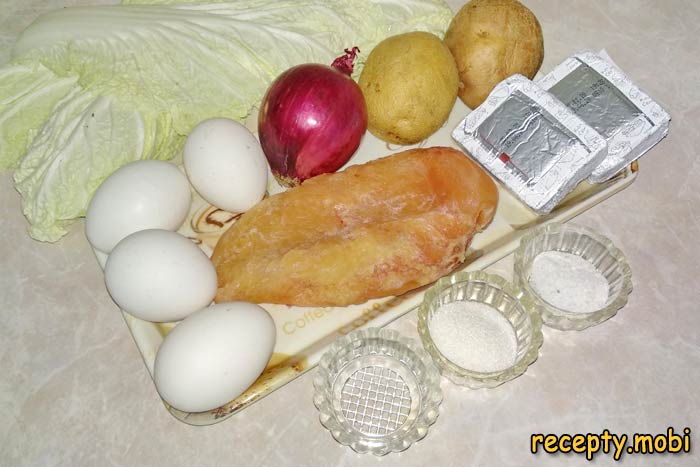
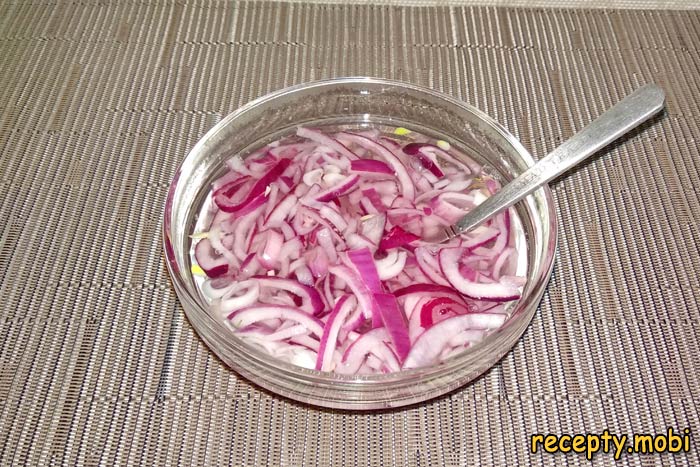
I slice the red onion into thin half-rings, 2–3 mm thick, and pour over a marinade of 1 tsp salt, 1 tsp sugar, 2 tbsp vinegar and 100 ml boiling water. I leave it for 15–20 minutes – the marinade removes the bitterness and makes the onion sweet and crunchy. Without marinating, raw onion would stand out too sharply in this delicate salad.
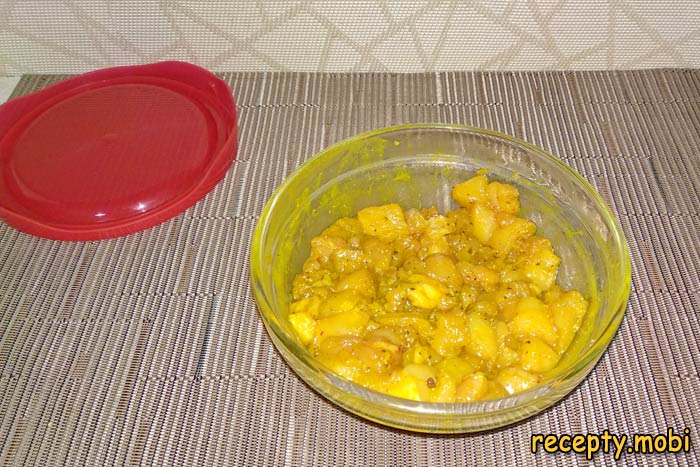
I cut the chicken fillet into small 1 cm cubes and pour over a mixture of 2 tbsp soy sauce and my favourite spices (paprika, black pepper, dry garlic). It marinates for 20 minutes – the soy sauce brings out the flavour of the chicken and gives it a golden crust when fried. Without marinating, the chicken would be bland.

I mix the chicken thoroughly with the spices by hand, so that every piece soaks up the marinade. You can add a teaspoon of vegetable oil – it helps the spices "dissolve" better and spread through the meat. A marinade of oil and soy sauce is a universal base for chicken fillet.
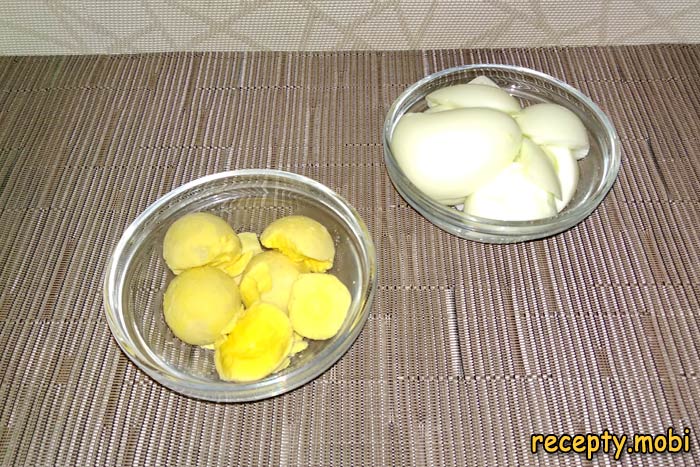
I peel the boiled eggs and carefully separate the whites and yolks. I set the yolks aside for the middle "yellow" layer of the salad, and keep the whites for the top "snowy" layer. Keeping them separate is the basis of the "wedding dress" effect in the finished salad.
I grate the yolks on a fine grater straight into a separate dish. A fine grater gives a "dusty", airy texture that is ideal for a layered salad. The grated yolks have a rich yellow colour – the basis of the salad's colour contrast with the snow-white top of whites.
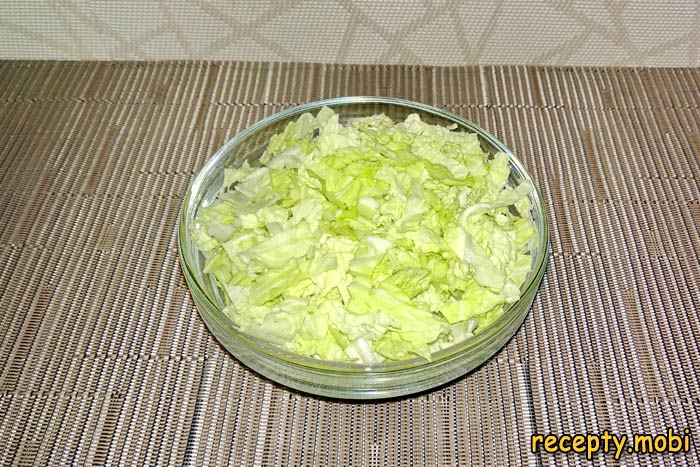
I rinse the Chinese cabbage leaves under cold water, remove the hard white part of the stalk and finely shred them into thin strips, 3–5 mm wide. I use only the tender upper "leafy" parts – the coarse stalks would spoil the texture. Chinese cabbage gives a light crunch and a delicate flavour, ideal for layered salads.
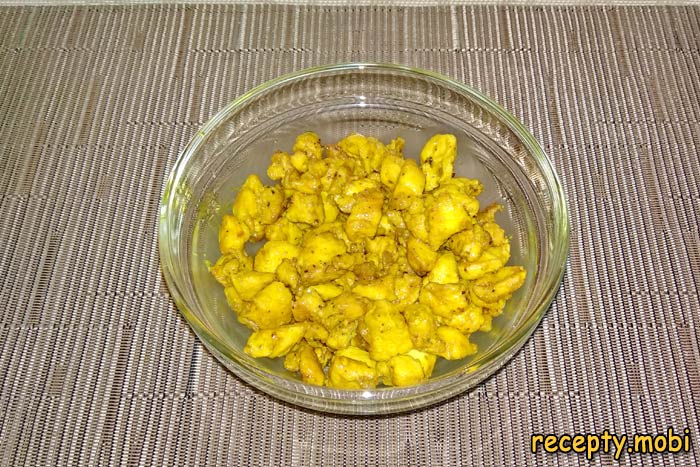
I fry the marinated chicken fillet in a heated pan with vegetable oil for 7–10 minutes, until golden brown and fully cooked. I check that it is done – inside, the meat should be white, with no pink streaks. I cool the fried chicken completely before assembling – hot chicken would "melt" the mayonnaise.
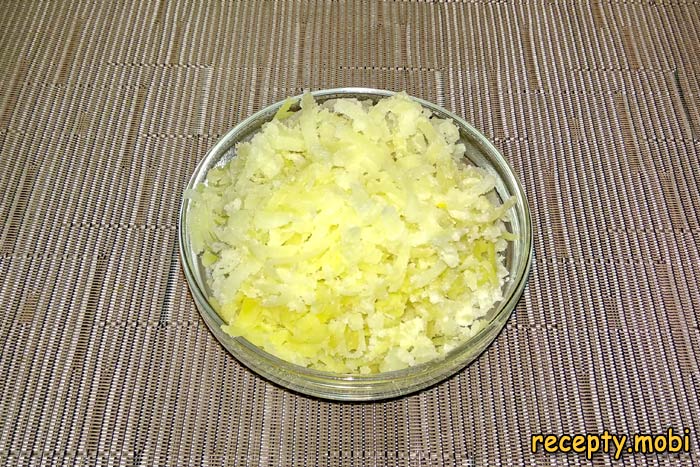
I grate the boiled, cooled potatoes on a coarse grater for an airy texture. I use a coarse grater – a fine one turns the potato into a purée that loses its shape. The grated potato forms an even base for the layered salad, without "lumps".
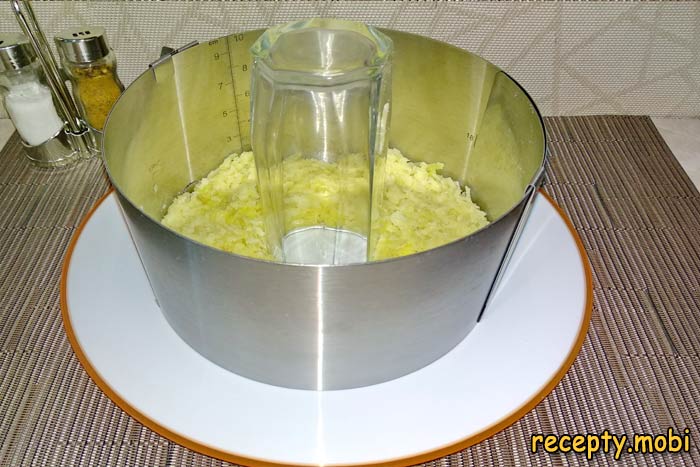
I set a cooking ring on a serving dish and place a glass upside down in the centre – this creates the "wedding ring" shape (optional). The first layer is grated potato; I level it and season it lightly with salt. The potato works as a neutral base for all the bright layers that follow.
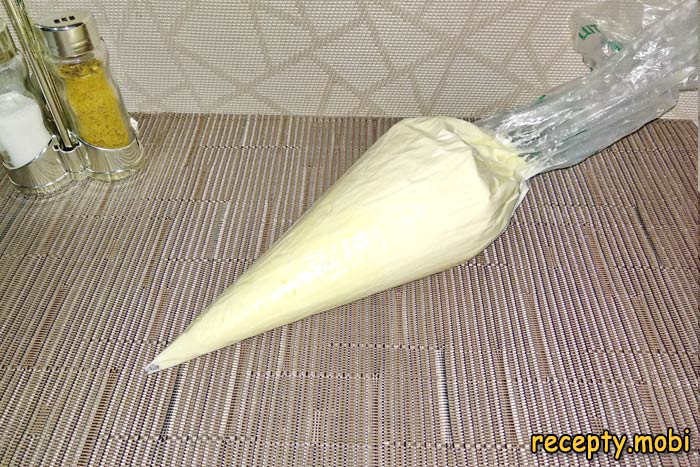
I make homemade mayonnaise: in a blender bowl I combine 1 egg, 1 tsp mustard, salt, lemon juice and 200 ml vegetable oil. I whisk at maximum speed to a thick emulsion. I transfer it to a piping bag with a fine nozzle – this makes it easier to apply an even "net".
I pipe a thin mayonnaise net over the potato layer – not too much, so as not to "drown" the potato. A net from the bag gives perfectly even coverage with no excess. Without mayonnaise the layers would "fall apart" when served.
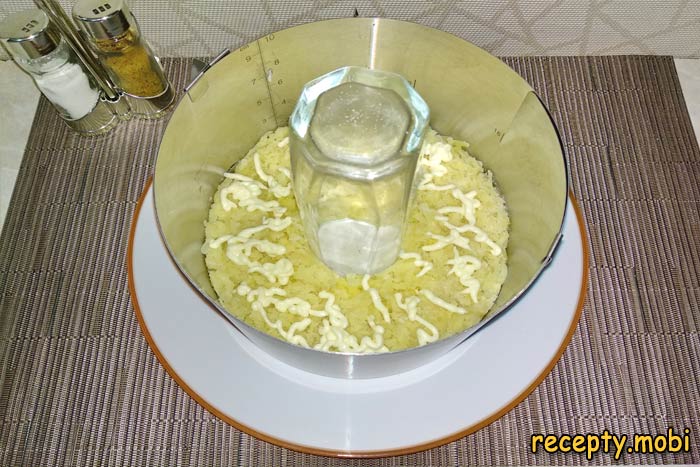
I add the cooled fried chicken as the next layer, on top of the potato and mayonnaise. The chicken is the main protein component of the salad. I spread it evenly, with no "mounds" or empty spots. I press the chicken down lightly with a spoon to compact the layer.
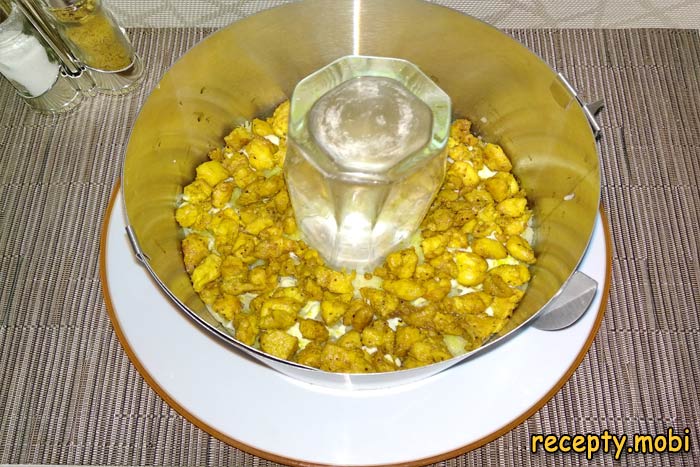
I lay the onion, squeezed out of its marinade, over the chicken in an even layer. The onion must be squeezed out thoroughly – excess marinade would "run" through the salad and spoil the layering. The pickled onion gives a piquant, sweet tang that goes perfectly with the chicken.
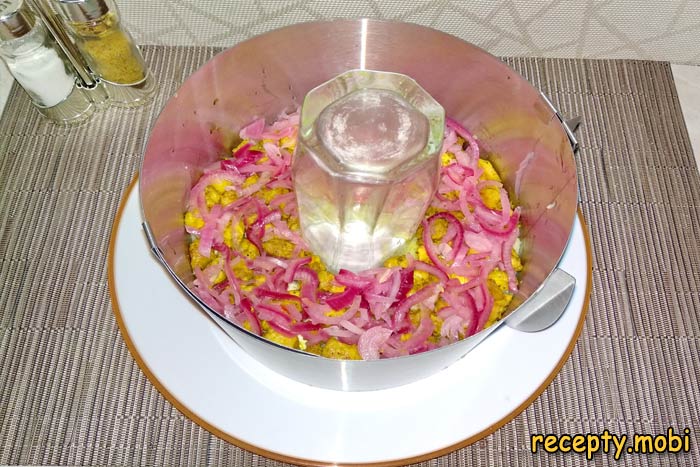
I add a layer of grated yolks, level it neatly with a spoon and pipe a mayonnaise net on top. The yellow colour creates a bright contrast with the white layers around it and works as a "sunny" decoration inside the salad. The mayonnaise net binds the yolks to the other layers.
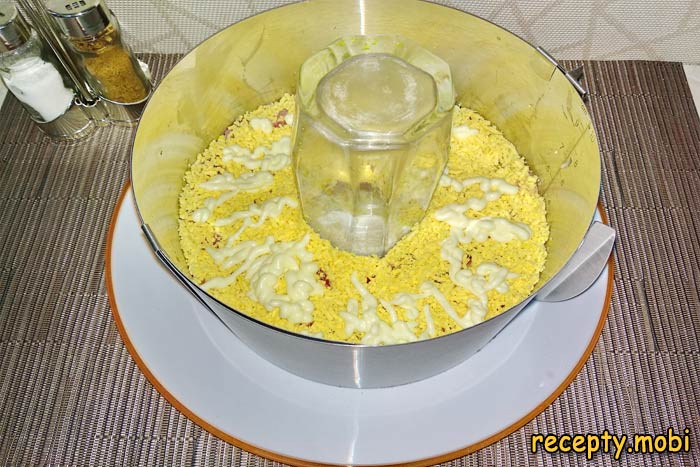
The next layer is the shredded Chinese cabbage; I spread it evenly and press it down lightly. On top I pipe a little mayonnaise to bind it. The Chinese cabbage gives "freshness" and a crunchy contrast to the soft potato, chicken and egg layers.
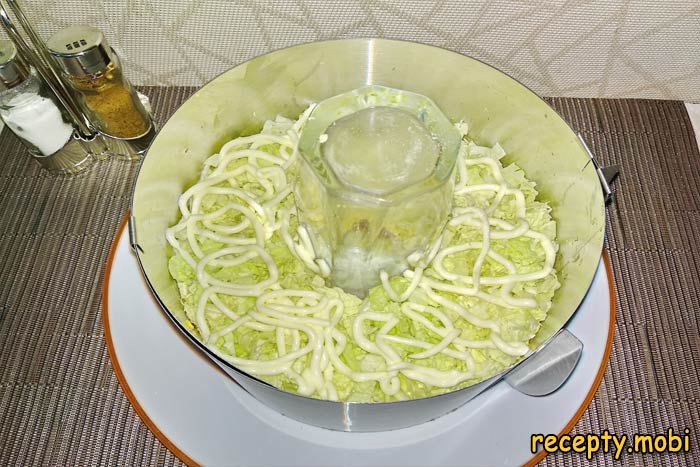
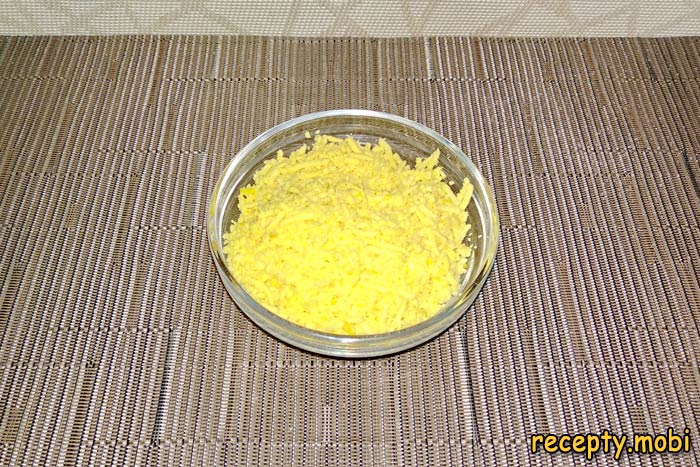
I grate the processed cheese (2 pcs) on a fine grater – to make this easier, keep it in the freezer for 30 minutes beforehand. I lay it in a layer over the cabbage and pipe the final mayonnaise net. The cheese gives a creamy tenderness and works as a "base" for the final white layer.
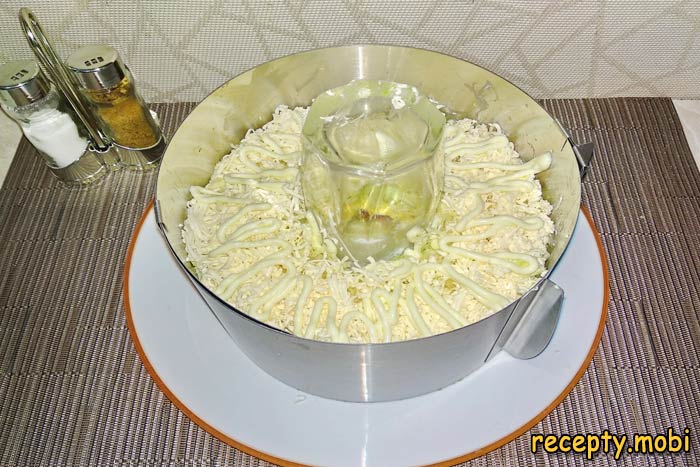
The final layer is the egg whites, grated on a fine grater straight over the salad. I do not press them down – they should stay airy and fluffy like "snow" or the hem of a wedding dress. This is the signature "bridal" white top that gave the salad its name.
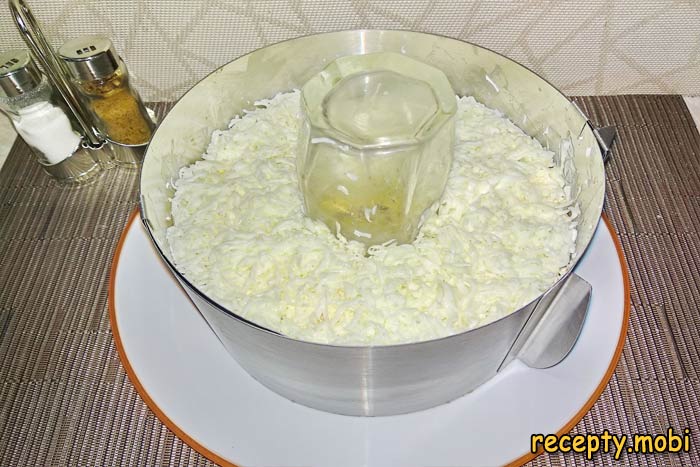
I carefully lift out the glass from the centre and remove the cooking ring – all the layers are clearly visible on the sides, and in the centre there is a hole like that of a wedding ring. I leave it in the fridge for at least 2–3 hours so the layers soak through – without resting, the flavour would be "raw".
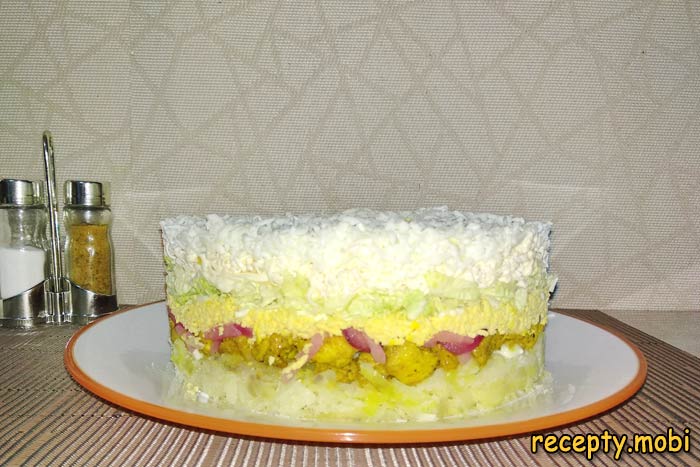
The Bride salad is ready! There should be a minimum of garnish – let the "snowy" white top speak for itself. You can scatter over a sprig of greenery or add a little finely grated yellow cheese for contrast.
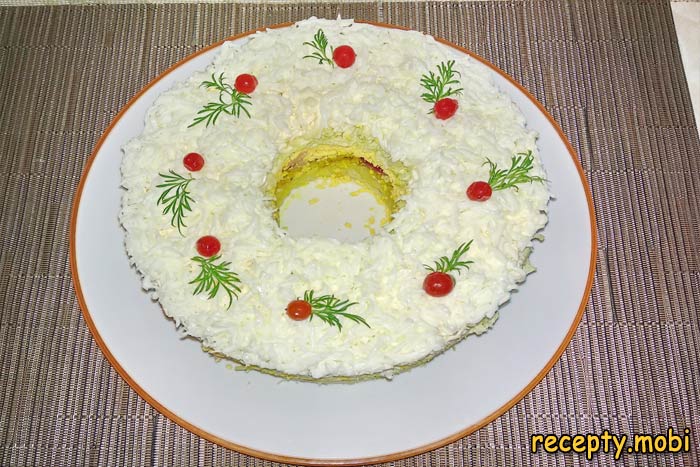
I serve the Bride salad chilled, on the festive table.
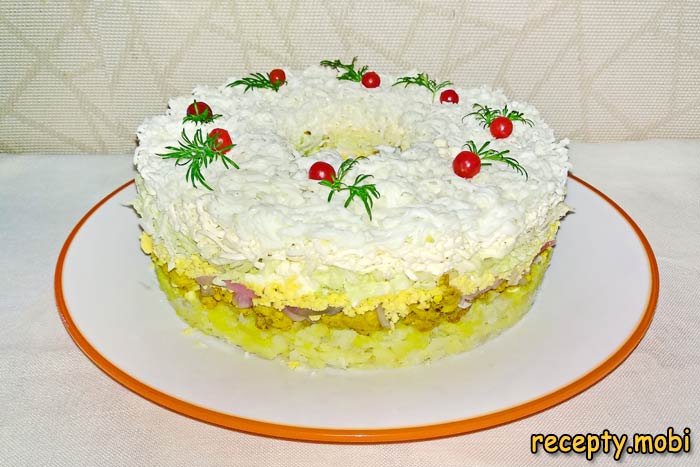


Tips
- 1
You can assemble the salad in the shape of a wedding ring – use a cooking ring with a glass in the centre; it looks striking on wedding tables.
- 2
Chicken marinated in soy sauce is more fragrant and tastier than plain boiled chicken – be sure to give it 20 minutes to soak up the flavour.
- 3
The top layer of whites should be light and airy – do not press it down when you spread it. I use the same principle for Mimosa salad.
- 4
Let the salad rest for 2–3 hours in the fridge before serving – the layers will soak into one another and the flavour will become harmonious.
FAQ
Can I make it with smoked chicken? +
Yes, smoked chicken will make the salad even more fragrant. Use smoked breast cut into small 1 cm cubes. In that case there is no need to marinate it – smoked meat already has a rich flavour. There is no need to fry it either – serve it cold. The calorie count will increase a little because of the fattiness of the smoked meat. A good compromise is to leave part of the chicken smoked (for aroma) and to boil or fry the rest (for the tenderness and juiciness of the layer).
What can I use instead of Chinese cabbage? +
A fresh cucumber cut into small cubes works well (it gives a crunchy juiciness), as do iceberg lettuce leaves (a tender texture and a neutral flavour), or finely shredded white cabbage lightly crushed with salt. You can also add grated apple – it gives a sweet tang and freshness. The salad will still be tasty without cabbage, but it will lose its crunch and freshness. Chinese cabbage is the most tender and the best choice for layered salads with chicken.
How long should the finished salad rest? +
At least 2–3 hours in the fridge, ideally overnight (8–10 hours). During this time the layers soak up the mayonnaise and the flavours come together into a single, harmonious whole. A freshly made salad tastes "raw" – you can feel the ingredients separately. After resting, the Bride is at its best. Do not leave it at room temperature for more than 2 hours – mayonnaise and chicken spoil quickly in the warmth, especially homemade mayonnaise without preservatives.
Can I substitute the processed cheese? +
Yes, you can replace the processed cheese with ordinary grated hard cheese (Russian, Dutch, Gouda). Hard cheese gives a more distinct "cheesy" flavour, while processed cheese gives a tender, creamy smoothness. Mascarpone or cream cheese (50 g) will also work – it gives even more tenderness. You can do without cheese altogether – replace it with an extra layer of mayonnaise or cucumber. Each substitute gives the salad its own character, while the basic "bridal" concept is preserved.
- Comment
or post as a guest
Be the first to comment.