avg —
Pickled Patissons with Zucchini for Winter

Instructions
I prepare the ingredients for a pretty jar of pickled patissons with zucchini for winter. Instead of dark zucchini you can use light marrows if you like – the taste will be the same, just less striking to look at.
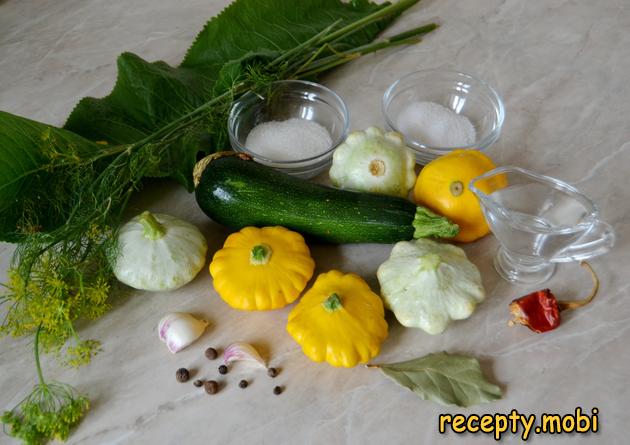
For a beautiful and tasty preserve I choose small young patissons – these fit whole into the jars, with no need to cut them into pieces. Small ones also turn out crisper than large ones. A size of 5–7 cm in diameter is ideal.
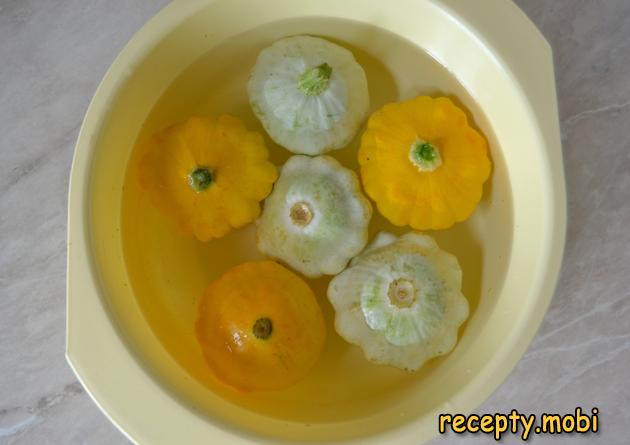
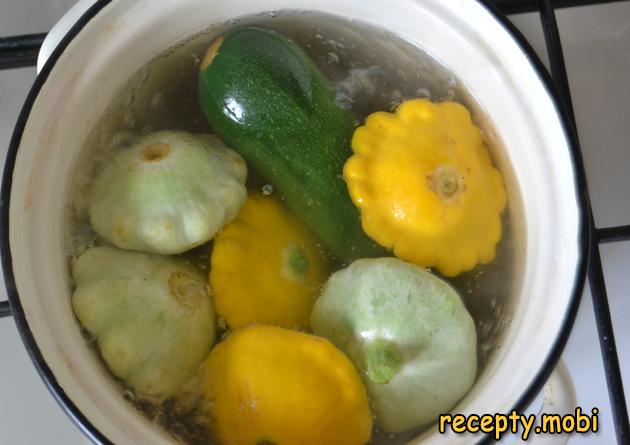
I blanch the patissons and zucchini for 4–5 minutes in boiling water, then put them into cold water to cool. Blanching is an important step: it removes the bitterness of the young vegetables and keeps them crisp after pickling. Without it the patissons can turn out watery.
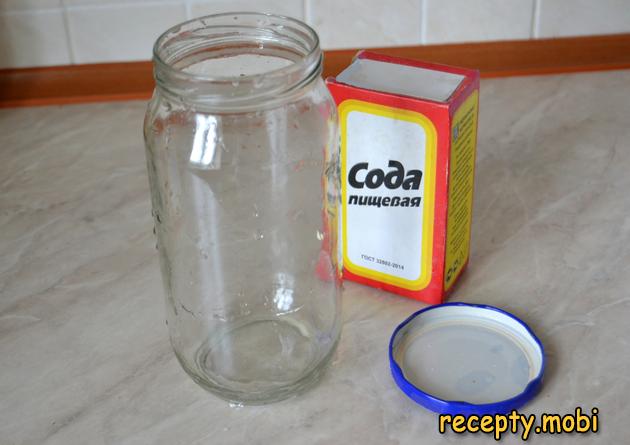
I wash the jar for canning in warm water with baking soda, then sterilise the washed jar with steam. Sterilisation is essential – without it even a perfect preserve can spoil within 1–2 months.
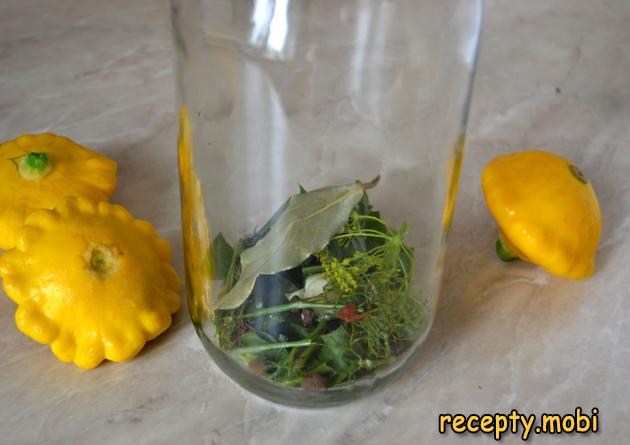
I fill the prepared jar with herbs and spices. Into a 1-litre jar I put a couple of sprigs of dill with umbels, half a horseradish leaf (cut crosswise into strips), the bay leaf, the peppercorns and a ring of hot pepper (no more than 0.5 cm). I peel and slice the garlic and add it to the jar. All these ingredients are classics of pickling that give the characteristic Russian flavour.
I cut the stem ends off the patissons, using the sharp tip of the knife to cut out any dark spots. I also trim the tip on the opposite side. I check each patisson carefully – a single dark spot can spoil the whole jar.
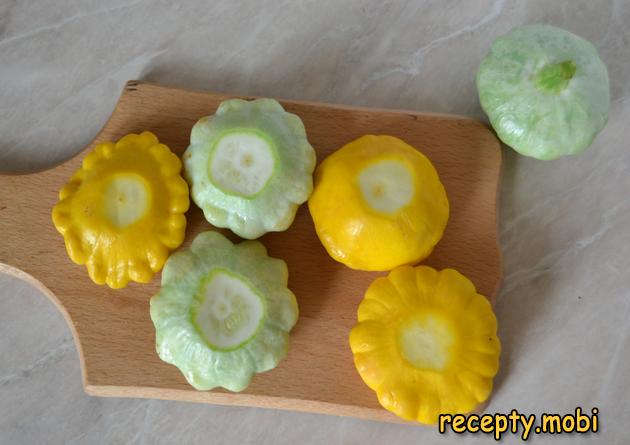
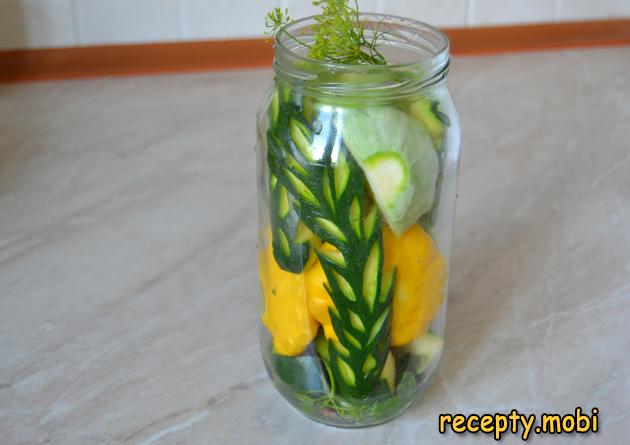
I pack the patissons tightly into the jar. The zucchini can be sliced into rounds, but the dark green vegetables look lovely cut into shapes – I carve little "flowers" or "twigs" from them for decoration. This already makes a "festive" presentation in glass.
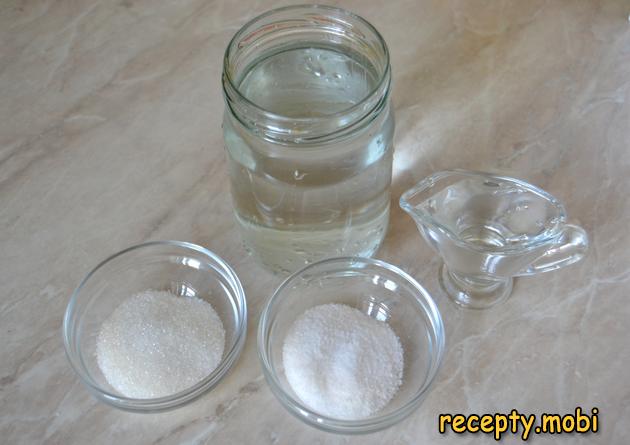
I make the marinade: I pour 0.5 litres of water into a small saucepan and put it on the heat. I mix the salt with the sugar and add it to the water. I boil the syrup gently under a closed lid for 5 minutes – the salt and sugar should dissolve completely into a uniform brine.
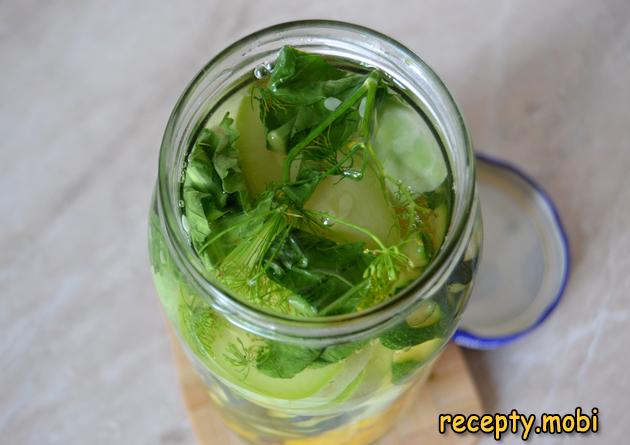
I add the vinegar according to the recipe straight into the jar with the vegetables, then pour in the hot syrup. I cover the jar with a sterilised lid right away. I shake the jar gently so no air bubbles remain between the vegetables. I let it stand for 5 minutes on the table – the temperature will even out before sterilisation.
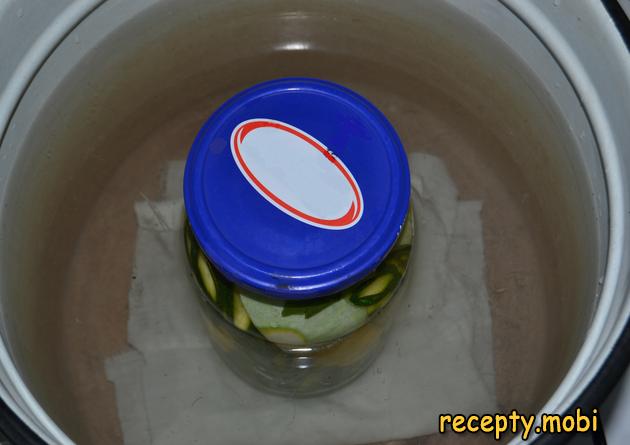
I line the bottom of a tall saucepan with cloth (so the jar does not rattle) and place the jar in it for sterilising. I pour in slightly hot water up to the shoulders of the jar and turn on the heat. When the water in the saucepan boils, I start timing the sterilisation. A 1-litre jar needs 20 minutes. I adjust the heat so the water boils steadily but does not bubble fiercely.
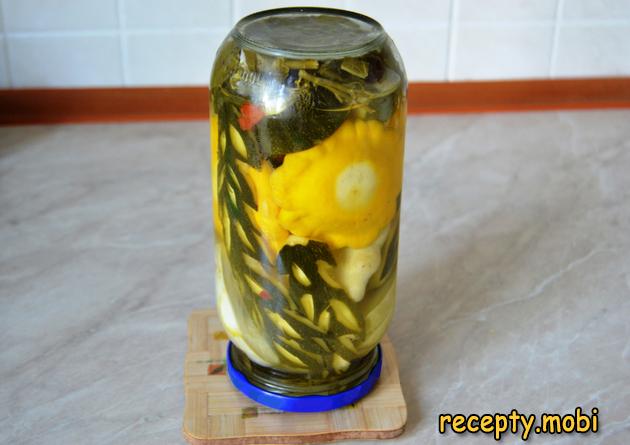
After 20 minutes I lift the jar out of the boiling water with special tongs, without removing the lid. I screw it down tightly and turn it upside down onto its neck. I leave it to cool completely without covering it with anything – this is how you check the seal. Once cool, I move the preserve to a dark, cool place for storage.


Tips
- 1
Choose SMALL patissons – 5–7 cm in diameter. They are crisp, fit neatly into the jar whole and do not need to be cut.
- 2
Blanching for 4–5 minutes is an essential step for a crisp result. Without it the patissons can turn watery and limp in the marinade.
- 3
Sterilise ALL jars and lids with steam or in the oven – this is the basis of safe preserving. I use a similar approach in other pickled preserves.
- 4
A horseradish leaf gives the characteristic "preserve" aroma and helps keep the vegetables crisp. Without it the jars are less expressive in flavour.
FAQ
How do I choose the right patissons for preserving? +
The ideal patissons are young (5–7 cm in diameter), with firm smooth skin, no spots or damage, and yellow or light green in colour (the classic "Sunny" variety). Old, large patissons (15 cm and more) are not suitable for pickling – they have tough skin and large seeds inside. Freshly picked ones taste better than those that have sat in the shop, so preserve them on the day of purchase. They should feel firm, with no soft spots. In the fridge they keep for up to 3 days, but it is best to preserve them straight away.
Can I use ordinary marrows instead of zucchini? +
Yes, ordinary light marrows are a full substitute for zucchini. The taste will be almost identical. Visually zucchini is more striking – its dark green colour gives a beautiful contrast with the yellow patissons. Marrows are lighter than the patissons, so the jar will look more "uniform" in colour. For a beautiful presentation you can mix dark green zucchini, light marrow and yellow patisson – you get a "tricolour" in the jar. The size should likewise be young, up to 15 cm long, with underdeveloped seeds.
How long does the preserve keep? +
With proper sterilisation and sealing – up to a year in a dark, cool larder (up to +20 °C) or in a cellar. Keep an opened jar in the fridge for a maximum of 2 weeks – after that the vinegar loses its preserving properties. Signs of a spoiled preserve: a bulging lid, cloudy brine, mould on top, a sour smell. At the slightest doubt – do NOT eat it (risk of botulism). A good preserve makes bubbles on the lid when opened and has a clean "marinade" aroma.
How do I serve pickled patissons? +
I serve them as an appetiser with main dishes: shashlik, fried meat, pilaf, potatoes. They are excellent with a glass of cold vodka at family gatherings. I cut them in half or leave them whole, depending on size. The marinade can be used too: to dress a vinaigrette salad, as a "brine" for other dishes, or simply drunk (a Russian classic). Garnish the dish with a sprig of dill from the jar for an attractive presentation. They go with any "heavy" dishes, freshening them up with their acidity.
- Comment
or post as a guest
Be the first to comment.