avg —
Strawberry and Pitted Cherry Jam

Instructions
I prepare fresh berries for the jam. I buy strawberries and cherries in season (June–July) at the market from trusted sellers, or pick them from my own garden. The berries should be RIPE but firm – overripe, soft ones will fall apart into mush during cooking.
I prepare the cherries (250 g). I wash the berries thoroughly under cold running water in a colander. If any stems are still attached, I pull them off. I soak the cherries in lightly salted water (1 tsp of salt per 0.5 l of water) for 15–20 minutes – a "trick" for checking for worms. Fruit worms float to the surface.
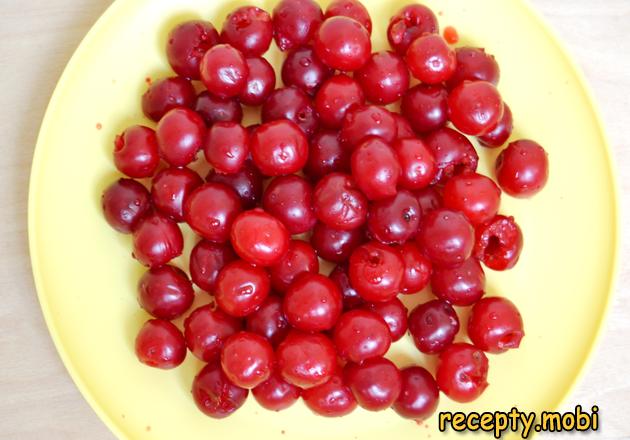
After soaking, I rinse the cherries again in clean water twice. I REMOVE THE PITS from the cherries with a special pitting tool (if you have one) or an ordinary safety pin. The safety-pin method: insert the loop of the pin into the hole left by the stem, catch the pit with the loop and pull it out. I discard the pits.
I prepare the strawberries (300 g). I WASH THE STRAWBERRIES VERY CAREFULLY – the fruit is delicate and easily damaged. The best way: I put the strawberries in a bowl of cold water, stir VERY GENTLY by hand for 30 seconds and drain the water. I repeat this once more. Do not pour water onto the strawberries with force – it will damage the fruit.
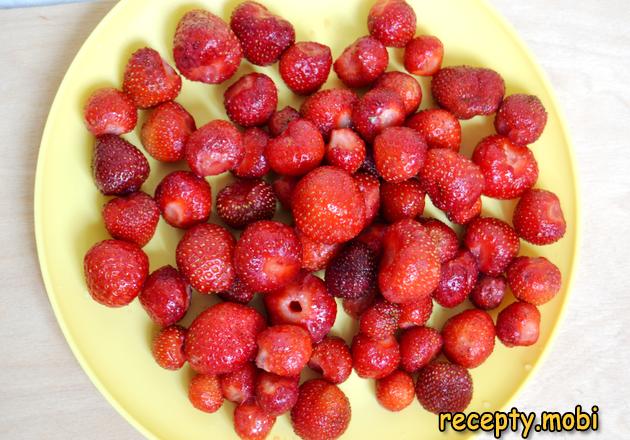
After washing twice, I pull off the strawberry caps (the green "tails"). If the strawberries are large, I cut each berry in half or into 4 pieces. I leave small strawberries whole – they look nicer in the finished jam. I prepare sterile 0.5 l jars and lids.
I combine the prepared strawberries and pitted cherries in a large, deep bowl or enamelled pan for cooking the jam. If you like, I add the seeds from ½ a vanilla pod or vanillin (1 g) for a gentle aroma.
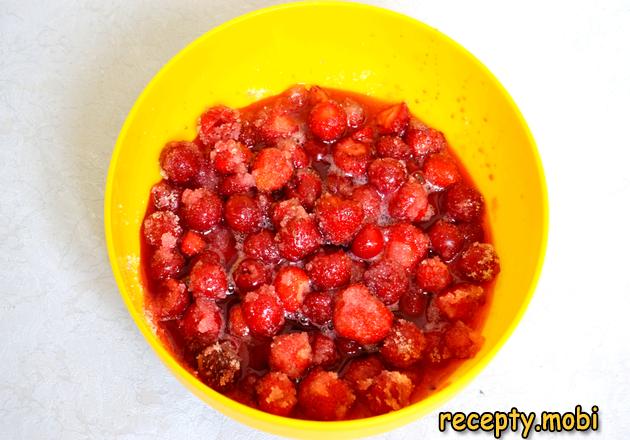
THE CRITICAL STEP: I cover the berries with sugar (400 g) and stir gently with a silicone spatula. I leave them for 30–45 minutes at room temperature. During this time the berries release plenty of juice and most of the sugar starts to dissolve in it. Do not skip this step – it is the "secret" of a proper jam.
After 30–45 minutes I transfer the berry mixture with its juice into the cooking vessel (an enamelled bowl, a heavy-bottomed pan or a jam basin). I set it over medium heat and bring it to the boil, stirring constantly with a silicone or wooden spatula – gently, so as not to damage the berries.
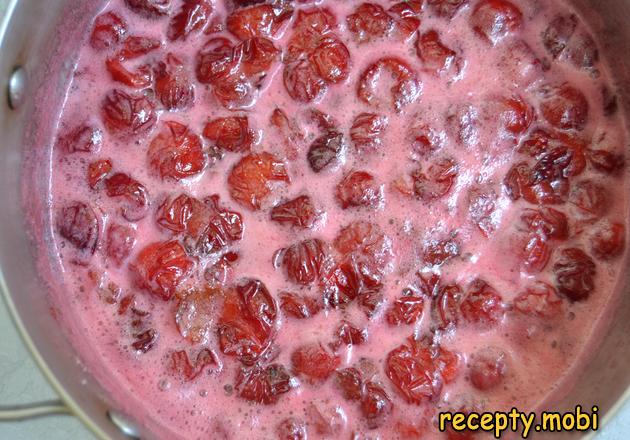
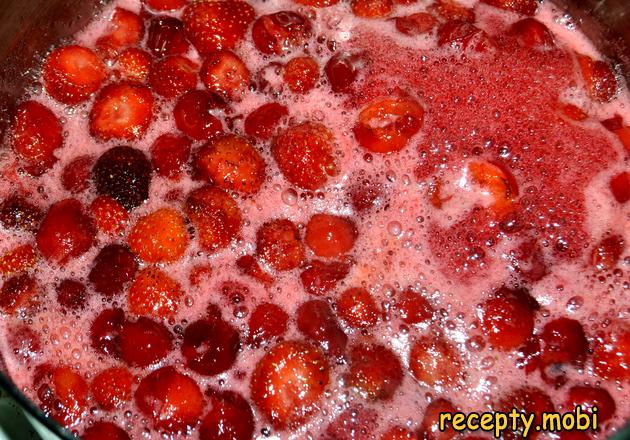
As soon as it comes to the boil, a lot of white foam forms on the surface – this is normal for berry jam. I skim the foam off thoroughly with a wooden spoon or a slotted spoon, as it makes the finished jam cloudy. Keep skimming the foam throughout the cooking.
I reduce the heat to LOW and cook the jam for 10 minutes from the moment it boils. If you like, at the end I add fresh lemon juice (1 tbsp) – it intensifies the berry flavour and helps the jam keep longer. Lemon juice also "fixes" the bright colour of the berries.
The finished jam has whole, firm berries in a thick, bright red syrup. To test for doneness: drop 1 tsp of hot jam onto a cold plate – after a minute the drop should "set" and not "run". If it is still runny, cook for another 5 minutes.
I prepare a 0.5 l glass jar and a metal lid. I wash the jar thoroughly in a hot soda solution and rinse it with boiling water. I sterilise the jar with steam over a kettle for 5 minutes, or in the oven at 100°C for 10 minutes. I boil the lid separately for 5 minutes.
I carefully spoon the HOT jam into the sterilised jar right up to the top, trying not to damage the berries. I immediately seal the jar tightly with a metal lid using a sealing key, or screw on a "twist-off" lid.
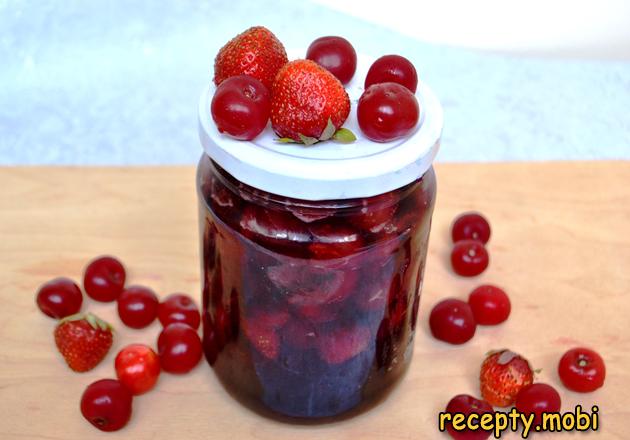
I turn the sealed jar upside down (onto the lid) and leave it like this until it has cooled completely (12 hours) – "extra sterilisation" by the jam's own steam. Then I return the jar to its normal position. I store it in a cool, dark place (cellar, pantry) or the refrigerator for up to 1–2 years. The strawberry and pitted cherry jam is ready!


Tips
- 1
ALWAYS cover the berries with sugar for 30–45 minutes before cooking – it is the "secret" of a rich syrup without separation.
- 2
Soak the cherries in lightly salted water for 15–20 minutes – a check for worms. Without it you may get "surprises".
- 3
Wash the strawberries VERY CAREFULLY – the delicate fruit is easily damaged. Using the same principle, I also make strawberry jam without cherries.
- 4
Skim the foam off thoroughly while cooking – it makes the finished jam cloudy and spoils its appearance.
FAQ
Can I replace the strawberries or cherries in this recipe? +
Yes, the jam can be made from any berry duets. Good combinations: raspberry + currant (a fragrant summer mix), strawberry + raspberry (double aroma), cherry + plum (a fruity autumn version), blueberry + gooseberry (an unusual pairing), currant + gooseberry (a classic), blueberry + bilberry (a blue "forest" mix), apricot + peach (a golden summer jam). Keep the total berry weight at 550 g to match the proportion with 400 g of sugar. Each duet gives its own character. Strawberry + cherry is a "classic" because of the perfect balance of a sweet and a tart berry.
How much sugar do I need for the jam? +
The standard proportion for Russian jam is 1:1 (1 kg of sugar per 1 kg of berries). For long storage and tart berries (currants, gooseberries) use 1.2:1 (more sugar). For very sweet ones (pears, bananas) use 0.8:1 (less sugar). In our recipe there is 400 g of sugar to 550 g of berries (a ratio of 0.7:1) – medium sweetness. With less sugar than 0.7:1 the jam will turn sour within 1–2 months of storage. With more sugar than 1.2:1 you get a "sugary mass" with no berry flavour. Never reduce the sugar below 0.7:1 – the natural sugar of the berries is not enough for natural preservation without adding more.
How long does the finished jam keep? +
Jam that has been properly sterilised and sealed keeps in a cool, dark place (5–15°C) for up to 1–2 years. Keep an opened jar in the refrigerator under the lid for up to 1 month. On a flat's balcony (without temperature swings) it also keeps for up to a year. Signs of spoilage: fermentation (bubbles, a sour smell), mould on the surface, a change in colour. If the jam has "crystallised", re-cook it with 50 ml of water and 1 tsp of citric acid. Do not throw "crystallised" jam away – it is safe to eat, it has simply lost its "liquid" consistency.
What do I serve strawberry and cherry jam with? +
The classic Russian way is with black or green tea as a treat in its own right. For breakfast: with pancakes, fritters, syrniki, cottage-cheese bake or doughnuts. On sandwiches – with butter and cream cheese (the French way). In yoghurt and cottage cheese as a fragrant sauce. With plombir ice cream – a berry sauce. For cakes: as a soak for sponge layers (dilute 1:1 with water), a filling for honey cake or chocolate cake. With a cheese board – with hard cheeses (Parmesan, Cheddar) for contrast. For a grown-up dessert – with white semi-sweet wine (Moscato) or sweet liqueurs such as Baileys.
- Comment
or post as a guest
Be the first to comment.