avg —
Tomatoes with Carrot Greens for Winter

Instructions
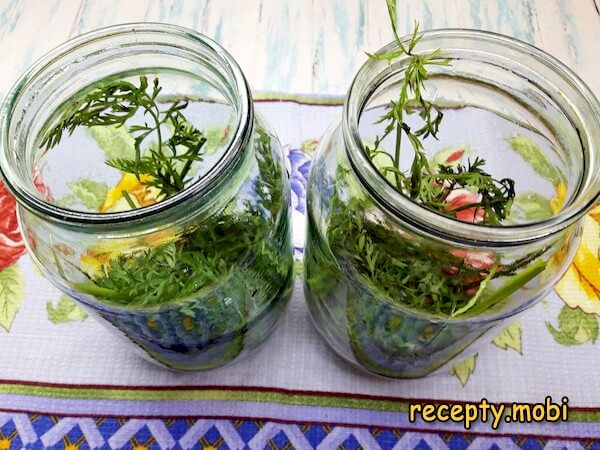
Wash all the ingredients; there is no need to dry them. Line the bottom of the jars with the carrot tops, curling them into a ring.
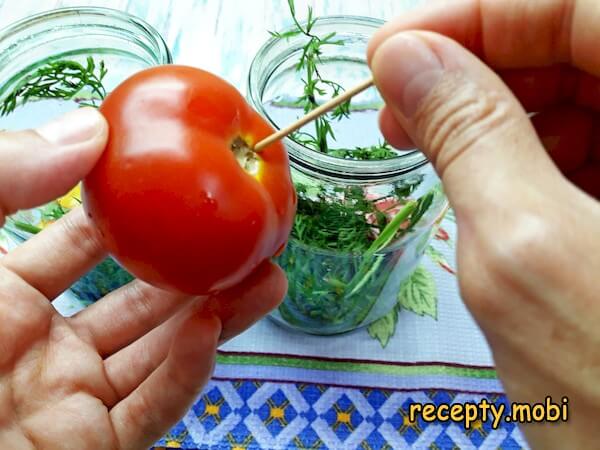
To keep the tomato skins from bursting when they meet the boiling water, pierce the flesh around the base of the stem with a toothpick and make a couple more holes on the other side.
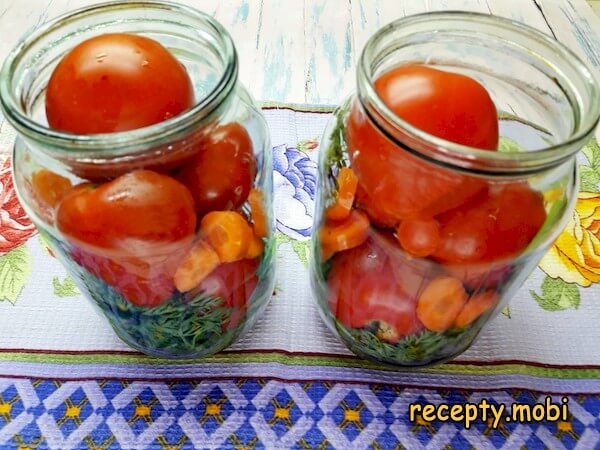
Pack the tomatoes into the jars over the carrot tops, pressing them tightly against one another. Bring the water to a boil.
Pour in the boiling water, then cover the jars with the lids and a towel. Leave the tomatoes like this to warm through.
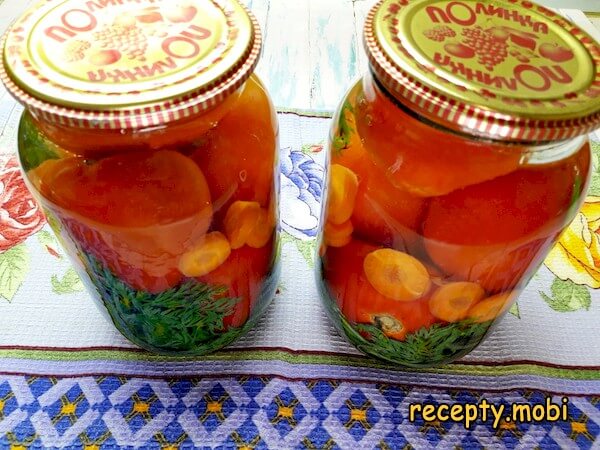
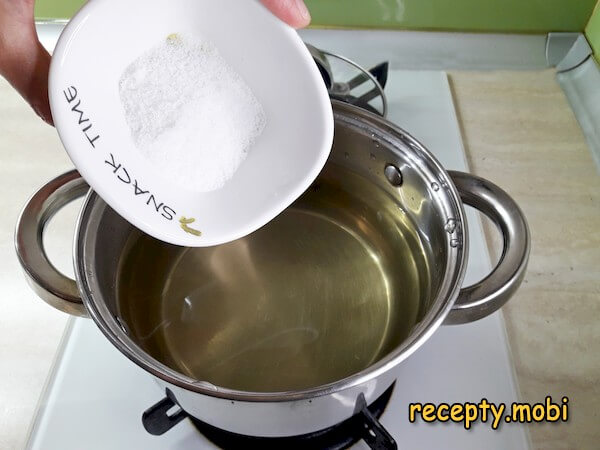
After half an hour the water will have cooled and you need to drain it into a pot, where the brine will be made (you can simply hold the tomatoes back with your palm, as the jars and water are no longer hot). Put the pot on the heat. Dissolve the salt, sugar and citric acid right in the pot. Wait for a steady boil.
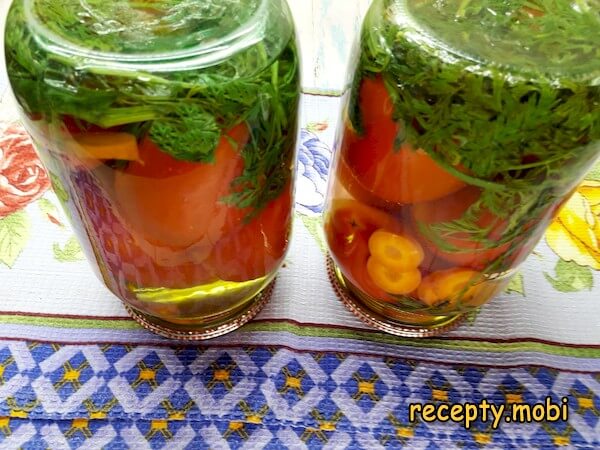
Pour the brine over the tomatoes and screw on the lids straight away. Check the seal by turning each jar upside down. If nothing leaks out from under the lid, move the jar under a warm blanket or quilt – this gives the seal extra sterilisation. Keep the jars in the warmth for at least 12 hours.You can keep tomatoes with carrot greens for winter even in an ordinary cabinet in a city flat. Bear in mind that it is best to open the preserve after 4 to 5 months, by which time the carrot leaves will have passed on all of their aroma to the tomatoes.Enjoy your meal!


Tips
- 1
Carrot tops are the "secret" of the aroma. The carrot greens give a light honey aroma and make the tomatoes slightly sweet. Without them you simply get ordinary marinated tomatoes.
- 2
A toothpick around the stem is the "secret" against bursting skins. Without the holes the tomatoes split from the boiling water and lose their shape.
- 3
Opening after 4 to 5 months is the "secret" of the flavour. The tops will have had time to pass their aroma to the tomatoes; opened earlier, the tomatoes will be "ordinary".
- 4
Citric acid instead of vinegar gives a mild tang. Vinegar is "sharp", while citric acid is natural – good for anyone who dislikes a vinegary taste. The same principle works in other kinds of winter tomatoes without vinegar.
FAQ
Which tomatoes should I choose? +
Ideally, medium tomatoes (5–7 cm) that are dense and meaty. Varieties such as Slivka, Damsky Palchik, Cherny Prints and Bychye Serdtse (the latter for larger jars) all work well. Avoid overripe tomatoes (they go mushy), green ones (too sour) and any that are cracked or bruised. Fresh tomatoes should be bright red and free of blemishes. The size should suit the jar – about 5 to 6 medium tomatoes fit a 1-litre jar. Yellow and green varieties also work and look unusual but pretty.
Where can I get young carrot tops? +
Ideally, freshly pulled young carrots from your own garden, with their green tops still on. Otherwise, look at a farmers' market, where carrots are often sold in bunches with the tops, or in a supermarket, where "farm" carrots sometimes come with their greens. Young tops should be bright green and springy, with no yellow stems. Do not use old tops (bitter) or wilted ones (they give no aroma). The carrot itself should be fresh (the 1/2 piece is an extra for the recipe). If you have no carrot tops, you can use dill umbels and parsley, though that becomes a different recipe.
How long do the tomatoes keep? +
In sealed jars at room temperature, up to 1 year (the author notes they can sit even in an ordinary kitchen cabinet). In a cool cellar, up to 1.5 years. Once opened, they keep in the fridge for 5 to 7 days. Write the canning date on the jars. If a lid bulges, do not open it – throw the jar away. Do not freeze them. It is best to use them 4 to 5 months after canning, when the tops have passed their aroma to the tomatoes. After a year the flavour fades and the tomatoes turn "vinegary". Use small 1-litre jars, which are easier to open; a large jar will spoil within a week of opening.
What do you serve the tomatoes with? +
The classics: with fried or boiled potatoes for a "country" serving, and with pelmeni and vareniki. They suit steak, shashlik and cutlets, as well as pasta or spaghetti. Serve them with dark or rye bread and salo, or with a chilled shot of vodka for a "Russian" serving. They make a good appetiser alongside borscht or shchi, and go with meat pies and meat-filled pancakes, or with boiled chicken or turkey. They belong on any family dinner table and pair nicely with a glass of red semi-sweet wine. A small jar is handy for a snack at the office, too – an all-round preserve for a Russian and Ukrainian table.
- Comment
or post as a guest
Be the first to comment.