avg —
Korean-Style Carrots for Winter: 4 Preserving Methods, Proportions, Storage Times and Safety

Instructions
Instructions
1. Wash and peel the carrots, then grate them into long, thin strips on a julienne (Korean carrot) grater. Put them in a deep bowl.
2. Add the salt (1 tsp) and sugar (3 tbsp), gently work them in with your hands and leave for 15-20 minutes: the carrots will release their juice and turn pliable.
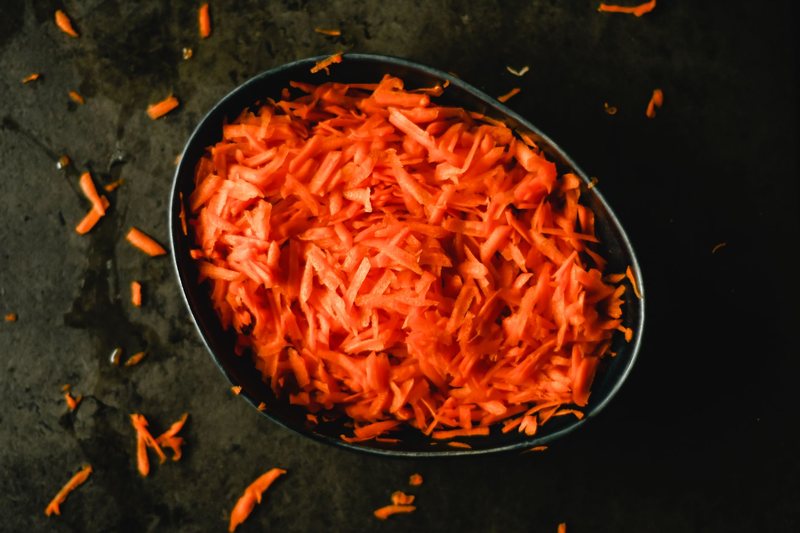
3. Pile the garlic pressed through a crusher (4 cloves), the coriander (2 tsp), black pepper (1 tsp) and chilli (1/4 tsp) into the centre in a little mound.
4. Heat the oil (1/2 cup) in a frying pan until it just starts to smoke and pour it straight onto the garlic and spices: they will burst into aroma. Stir well.
5. Pour in the vinegar (5-6 tbsp) and stir again. Cover the bowl with cling film and refrigerate for at least 6-8 hours, ideally overnight.
6. For winter preserving, sterilise the jars and lids. Pack the carrots in tightly, pressing them down, and pour in the juice-marinade they have released right up to the neck, working out any air bubbles.
7. Cover with the lids and sterilise 0.5 l jars in boiling water for 15 minutes (1 l jars for 20-25 minutes).
8. Seal with metal lids, turn the jars upside down and wrap them in a blanket until completely cool.
9. Store in a cool, dark place. The flavour opens up fully after 1-2 weeks.
Comparison of methods for preserving Korean-style carrots for winter
| Method | Sterilisation needed | Acid or preservative | Storage time | Where to store |
|---|---|---|---|---|
| Classic marinade pour-over (sealed jars) | Yes: jars plus 15-25 min for the preserve | Vinegar 6-9% | 8-12 months | Pantry, cupboard, cellar (cool and dark) |
| No sterilisation (boiling oil plus vinegar) | Jars only, not the preserve | Vinegar plus heated oil | 2-3 months | Fridge or cold cellar only |
| No vinegar / with lemon juice | Recommended | Lemon juice (weaker acid) | 2-4 weeks | Fridge only |
| Freezing | Not needed | None required (the cold does the work) | 4-6 months | Freezer at -18°C |
Variations
Classic winter version with a hot marinade pour-over (sealed jars)
The most reliable method for storing at room temperature. The carrots are seasoned with garlic, coriander, pepper and boiling-hot oil, just as in the hero recipe, but the brine is cooked separately. Per 1 kg of carrots, bring 1 cup of water to the boil with 3 tbsp of sugar and 1 tsp of salt, adding 5-6 tbsp of vinegar at the end. Pack the seasoned carrots tightly into sterile jars, pour over the boiling marinade and the smoking-hot oil right up to the neck, sterilise 0.5 l jars for 15 minutes and 1 l jars for 20-25 minutes, then seal. Keeps for 8-12 months somewhere cool. This is the pour-over marinade version that is not afraid of room temperature.
No sterilisation (boiling heated oil plus vinegar)
Quicker, with no fuss over a sterilising pan. The carrots are made to the base recipe, doused with boiling heated oil and vinegar, then packed tightly into sterile, dry jars. To make up for the lack of heat treatment, the acid and oil are increased: up to 7-8 tbsp of vinegar and up to 2/3 cup of oil per 1 kg. An honest word on shelf life: this preserve keeps only in the cold, for 2-3 months, and is never left somewhere warm. This is the popular no-sterilisation Korean-style carrot preserve for anyone with room in the fridge.
No vinegar / with lemon juice
For those who cannot have vinegar, on a gentle diet or for children's meals. The vinegar is replaced with the juice of 1-1.5 lemons (roughly 4-5 tbsp) plus a pinch of citric acid per 1 kg. The flavour is softer and more fragrant, but the acid is weaker, so vinegar-free Korean-style carrots are never sealed for room-temperature storage: the shelf life is shorter, 2-4 weeks in the fridge. It is a compromise: less sharpness, but less staying power too.
Spicy version (for those who like a bit of fire)
Spicy Korean-style carrots for winter are built on the same base, just with more heat. Increase the chilli to 1/2-1 tsp, add 1/4 tsp of hot red pepper flakes and an extra garlic clove. A pinch of paprika works well for colour and depth. Keep the acid and salt at the standard levels so the heat does not overwhelm the balance.
Sweet version
A mellow version without any harsh heat, popular with children and anyone who dislikes fiery food. Increase the sugar to 4-5 tbsp, halve the chilli or leave it out, and use the lower amount of vinegar (5 tbsp). Once cooled, you can stir in 1 tsp of honey. The carrots come out caramel-spiced with a gentle tang.
Freezing Korean-style carrots
An alternative to canning when there is no room or time for jars. Make the carrots to the base recipe, let them marinate, squeeze out a little of the excess juice and pack them flat in portions in bags or containers. At -18°C they keep for 4-6 months. Defrost in the fridge rather than the microwave, drain off the released water and refresh with a drop of vinegar and some fresh garlic: the flavour comes back almost as good as fresh.
With onion and sweet pepper
Korean-style carrots for winter with onion, garlic and strips of sweet pepper come out richer and more colourful. Per 1 kg of carrots add 1 large onion and 1 sweet pepper. An important note on storage: raw onion and pepper hold water, shortening the shelf life and raising the risk of fermentation. For sealed jars, fry the onion in the same oil and blanch the pepper. Keep the version with raw additions in the fridge and eat it within 2-3 weeks.
Homemade Korean carrot seasoning
When there is no shop-bought mix, put one together yourself: per 1 kg of carrots take 2 tsp of ground coriander, 1 tsp of black pepper, 1/4-1/2 tsp of chilli, 4 garlic cloves and salt. If you like, add 1 tsp of paprika and a pinch each of ground ginger and cumin. Coriander is the key ingredient: without it there is no recognisable Korean flavour. This is Korean-style carrots for winter with coriander and no ready-made seasoning: you control the blend yourself and can easily adjust the heat and aroma.
Storage and safety
Why jars swell and burst
A jar swells when bacteria or yeasts multiply inside and give off gas. Three typical causes: weak acidity (too little vinegar), poorly sterilised jars and lids, and trapped air together with raw untreated additions such as fresh onion. If the lid bulges and the brine turns cloudy and fizzy, that jar must not be eaten. That is the direct answer to why jars of Korean-style carrots burst.
How to prevent it
Three rules of preserving do the job. First: enough acid (6-9% vinegar at the full amount; do not cut it back for mildness if you are sealing jars for room-temperature storage). Second: sterility (boil or heat the jars and lids, and sterilise the filled jars for 15-25 minutes). Third: cleanliness (clean hands, boards, knives and fresh produce). Packing the carrots down tightly with no air bubbles and topping up with marinade right to the neck removes the pockets where fermentation starts.
The botulism risk and how to reduce it
Botulism develops in the oxygen-free environment of sealed jars when there is not enough acid. Korean-style carrots are relatively well protected because they contain vinegar, but the risk grows if you seal jars for warm storage with too little acid. The same three things reduce it: acid (vinegar or lemon juice), thorough sterilisation and cleanliness. Do not shorten the 15-25 minutes of heat treatment. Any jar that has swollen, turned cloudy or smells off goes straight in the bin without tasting: boiling it again will not save it.
Storage times for each method
Classic sealed jars with vinegar and sterilisation: 8-12 months somewhere cool. Without sterilisation, under a metal or plastic lid: 2-3 months, in the fridge or a cold cellar only. Vinegar-free with lemon: 2-4 weeks in the fridge. Freezing: 4-6 months at -18°C. An opened jar kept in the fridge should be eaten within 5-7 days.
Where to store it: flat, cellar, fridge, balcony
Sealed, sterilised jars sit perfectly well in a flat without a cellar: a dark pantry, cupboard or top shelf away from radiators, at room temperature, will do for the whole winter. A cellar is ideal but not essential. The fridge is needed for the unsealed versions (no sterilisation, no vinegar) and for every opened jar. A balcony only works if it stays reliably cool and the preserve never freezes through: in a hard frost the jar can crack, and once thawed the carrots turn limp and lose their crunch.
Yield and packing
From 1 kg of raw carrots you get roughly 1.3-1.5 kg of finished salad including the marinade: about three 0.5 l jars or one and a half 1 l jars. A 0.5 l jar takes roughly 350-400 g of packed carrots, a 1 l jar 700-800 g. The proportions scale linearly: for 2 kg of carrots, double everything. For a family it is more convenient to pack into 0.5 l jars, so an opened portion is eaten within a few days and never has time to spoil.
Troubleshooting
The carrots are soft and do not crunch
The cause is a fine grater (the carrots bleed their juice), limp carrots with little juice in them, or too much salt. A finished batch is hard to rescue, but you can stir in a portion of freshly grated strips and a splash of vinegar to liven it up. For next time: use a julienne (Korean carrot) grater, firm juicy carrots, salt in moderation, and do not let the carrots sit too long in the hot oil.
Too sour
Add 1-2 tsp of sugar and a handful of freshly grated carrot with no acid, stir and let it stand for an hour. The acid will spread across the larger volume and soften. Do not rinse it, or you will wash away the spices.
Too salty
Stir in some freshly grated carrot and a spoonful of oil: the salt will redistribute and mellow. Do not rinse the preserve with water, or all the flavour and spice aroma will go with it.
Too spicy
Work in some fresh carrot, a spoonful of oil and a pinch of sugar, and the heat will spread across the volume. On the plate, a spoonful of soured cream or plain yoghurt calms the heat nicely.
The brine has turned cloudy
If the jar has been standing somewhere warm and the brine has gone cloudy with bubbles and a sour fermented smell, the preserve is spoiled: throw it away without tasting. A slight haze right after sealing, caused by the ground spices, is harmless as long as the lid is flat and the smell is normal.
The jar has swollen or leaked
Do not open a swollen jar at the table; it goes in the bin: that is fermentation and a botulism risk. If a jar has leaked because of a poor seal and less than a day has passed, move it to the fridge and eat it within a week. A jar like that is never left in a warm place for the winter.
Not enough juice, the carrots are dry
Top up with boiling marinade (water with sugar, salt and vinegar) or heated oil right to the neck so the carrots are fully covered. Air pockets above the preserve are the number one cause of fermentation.
Common mistakes
- Grating the carrots on a fine grater instead of into strips: they bleed juice and turn to mush, with no crunch.
- Cutting back the vinegar or skipping sterilisation when sealing for room-temperature storage: the jars swell and ferment.
- Pouring the hot oil past the garlic and spices rather than onto them: the aroma never develops and the flavour stays flat.
- Closing with a plastic lid and leaving the jar somewhere warm: the preserve ferments.
- Sealing straight away without letting the carrots stand: the flavour has no time to develop.
- Salting and souring by eye without tasting: the result comes out too salty or too sour.
- Adding raw onion or sweet pepper and expecting long storage at room temperature: the shelf life drops sharply.
- Leaving the jars above a radiator or in the light: the preserve overheats and spoils faster.
Video
FAQ
How long do sealed jars of Korean-style carrots keep for winter, and how can you tell they have spoiled? +
Sealed with vinegar and sterilised, the carrots keep for 8-12 months in a cool, dark place. Without sterilisation, under a lid, they keep 2-3 months in the fridge. Spoilage shows as a bulging lid, cloudy or fizzing brine, a sour fermented or unpleasant smell, mould or slime. A jar like that is thrown away, not tasted.
Why do jars of Korean-style carrots burst and swell, and how do you prevent it? +
Because of fermentation: bacteria and yeasts give off gas that forces the jar open. The causes are too little vinegar, poorly sterilised jars and lids, trapped air, and raw additions such as fresh onion. Prevent it with the full amount of vinegar, thorough sterilisation of the jars and the preserve for 15-25 minutes, tight packing with no bubbles, and filling right to the neck.
Can the preserve be stored in a flat with no cellar, in a pantry or on a balcony? +
Yes. Sealed, sterilised jars sit happily in a flat: in a dark pantry, a cupboard or on a top shelf at room temperature, away from radiators and sunlight. A cellar is not essential. A balcony works only if it stays cool and the preserve never freezes: frozen and thawed carrots turn limp, and a jar can crack in a hard frost.
Is sterilising the jars and the preserve itself compulsory, or can you manage without? +
For sealing jars to keep all winter at room temperature, sterilising both the jars and the preserve is compulsory: it is the main defence against fermentation and botulism. Without sterilisation you can only make fridge versions with extra acidity, and those keep for 2-3 months in the cold, not at room temperature.
Can Korean-style carrots for winter be made without vinegar, and what can replace it? +
Replace the vinegar with the juice of 1-1.5 lemons (roughly 4-5 tbsp) plus a pinch of citric acid. The flavour is softer, and it suits anyone who cannot have vinegar. But the acid is weaker, so these carrots are not sealed for warm storage; they keep in the fridge for 2-4 weeks. For a long winter preserve, vinegar is more reliable.
What goes into Korean carrot seasoning, and what can replace the shop-bought mix? +
The base is ground coriander, black pepper, hot red pepper, garlic and salt, often with paprika. At home, per 1 kg of carrots, take 2 tsp of coriander, 1 tsp of black pepper, 1/4-1/2 tsp of chilli and 4 garlic cloves, plus 1 tsp of paprika and a pinch each of ginger and cumin if you like. Coriander is the key: without it there is no Korean flavour.
Why do the carrots turn out soft instead of crunchy, and how do you keep the crunch? +
The crunch is lost because of a fine grater (the carrots bleed juice), limp carrots with little juice in them, or too much salt, which draws the water out. What crunches is long, thin strips from a julienne grater, firm fresh carrots and moderate salt. The boiling oil is poured over the carrots, not used to cook them.
What do you do if the preserve has come out too sour, salty or spicy? +
Too sour: add sugar and a little freshly grated carrot, stir and let it stand. Too salty: likewise stir in fresh carrot and a spoonful of oil. Too spicy: work in fresh carrot, oil and a pinch of sugar. Never rinse the preserve, or you will wash away the spices. The rule: taste the marinade before sealing.
Can Korean-style carrots be frozen for winter, and how long do they keep in the freezer? +
Yes. Make them to the base recipe, let them marinate, squeeze out a little excess juice and pack them flat in portions in bags. At -18°C they keep for 4-6 months. Defrost in the fridge, drain off the water and refresh with a drop of vinegar and fresh garlic: the flavour comes back.
Which vinegar is best (9%, apple cider, essence) and how much do you need per 1 kg of carrots? +
Table vinegar at 9%, apple cider or wine vinegar at 6% all work. Per 1 kg of carrots you need 5-6 tbsp of 9% vinegar. Use slightly more apple cider vinegar, as it is milder. Handle 70% essence with care: about 1 tsp of essence replaces roughly 8 tbsp of 9% vinegar, and it must always be diluted. Never reduce the acid when sealing for room-temperature storage.
Why pour hot oil over the carrots, and does it need heating until it smokes? +
Boiling-hot oil releases the aroma of the garlic and spices in an instant: they flare up, so to speak, giving off their essential oils, and the flavour becomes brighter. Heating the oil until it just smokes removes any raw taste and lightly sanitises it. Pour the oil directly onto the mound of garlic and ground spices, not past it.
How much carrot do you need for a 0.5 l and a 1 l jar, and what is the yield from 1 kg? +
A 0.5 l jar takes roughly 350-400 g of packed carrots, a 1 l jar 700-800 g. From 1 kg of raw carrots you get about 1.3-1.5 kg of finished salad with the marinade, which is roughly three 0.5 l jars. The proportions scale linearly: for 2 kg, double everything.
Can you make it without a special Korean carrot grater? +
Yes. Cut the carrots into long, thin matchsticks with a knife, or use a coarse grater with elongated holes, or a food processor shredding attachment. The one thing to avoid is a fine grater: on it the carrots turn to mush, bleed juice and lose all their crunch.
Is botulism a danger in this preserve, and how do you reduce the risk when sealing? +
The risk exists where there is too little acid, but Korean-style carrots are protected by the vinegar. Three things reduce the risk: enough acid (vinegar or lemon), thorough sterilisation of the jars and the preserve for 15-25 minutes, and clean produce and utensils. Any jar that has swollen, gone cloudy or smells bad is thrown away without tasting.
Can you use plastic lids, or only crimped metal ones? +
For storage at room temperature all winter, use only crimped or screw-on metal lids with an airtight seal after sterilisation. Plastic lids are not airtight and are only good for versions kept in the fridge for 2-3 months. Under a plastic lid in a warm room, the preserve will ferment.
How many days after sealing can you eat it, and when does the flavour fully develop? +
You can try it after just 6-8 hours, but the flavour truly opens up after a day, once the carrots have soaked in the marinade, garlic and spices. Sealed jars should stand for at least 1-2 weeks. The longer it stands, within its shelf life, the richer the flavour and the mellower the heat.
Can you add onion, sweet pepper or hot pepper, and how does that affect storage? +
You can, and the flavour gets richer. But raw onion and sweet pepper hold water, which shortens the shelf life and raises the fermentation risk. For sealed jars, fry the onion and blanch the pepper; add hot pepper ground or fresh in small amounts. Keep versions with raw additions in the fridge and eat them within 2-3 weeks.
Should you squeeze out the juice before sealing? +
No, not for sealing: the juice becomes the marinade and pour-over, protecting the carrots from air and extending their storage. Squeeze it out only before freezing, so there is no excess water and ice in the freezer. If there is too little juice, top up with boiling marinade or heated oil right to the neck.
- Comment
or post as a guest
Be the first to comment.