avg —
Sauté of mushrooms (champignons) and tomatoes

Instructions
Rinse the snow-white mushrooms under running water and slice them into segments depending on the size of the champignons: small ones in half, medium ones into 4 pieces, large ones into 6–8 segments. The aim is for all the pieces to be roughly the same size for even frying.
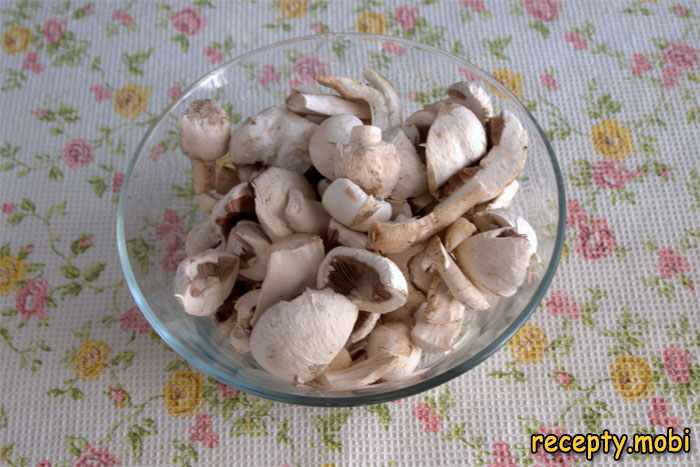
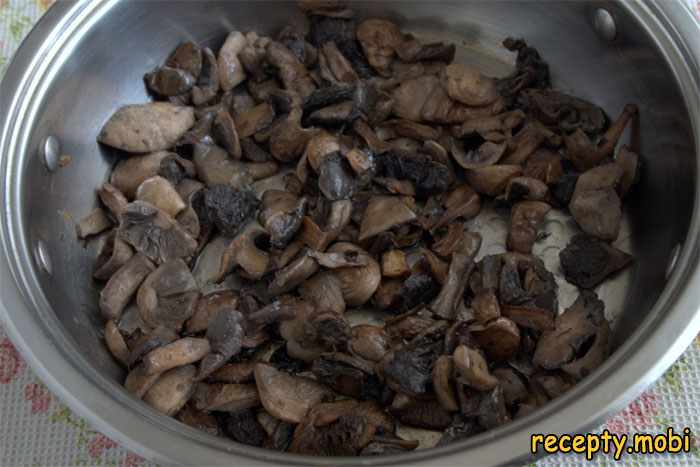
Place them in a sauté pan with hot oil. Cook over high heat until all the moisture has evaporated – this is a critical stage: mushrooms are 90% water to begin with, and over low heat they "stew" in their own juices, while over high heat they evaporate it and turn golden.
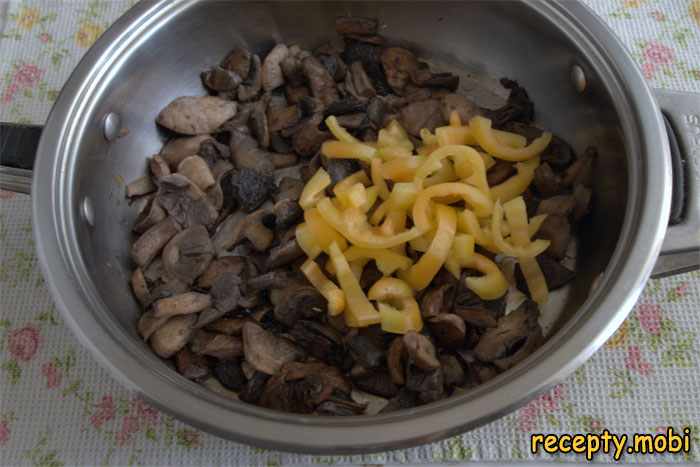
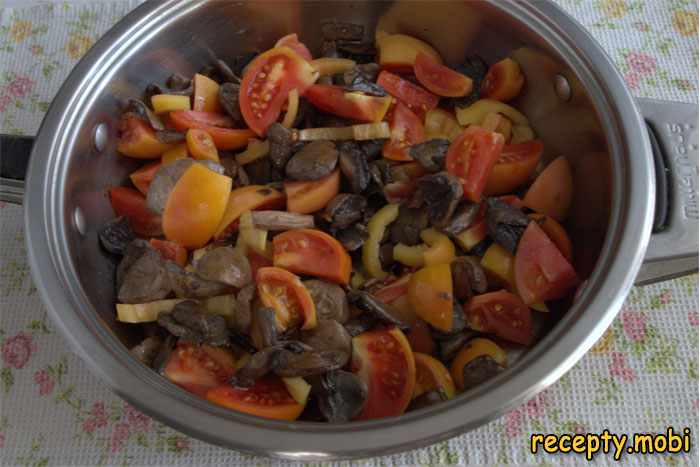
Slice the bell pepper of any variety or shade into strips 5–7 mm wide and add it to the dish – bright peppers (red, yellow, orange) give characteristic "colourful" accents to the finished dish.
At the next stage, add the pieces of tomato to the pan. In winter you can replace them with tomatoes canned in their own juice (without tomato paste – it would give a "marinade" character). Add a pinch of salt. If you like, add pieces of chilli for heat.
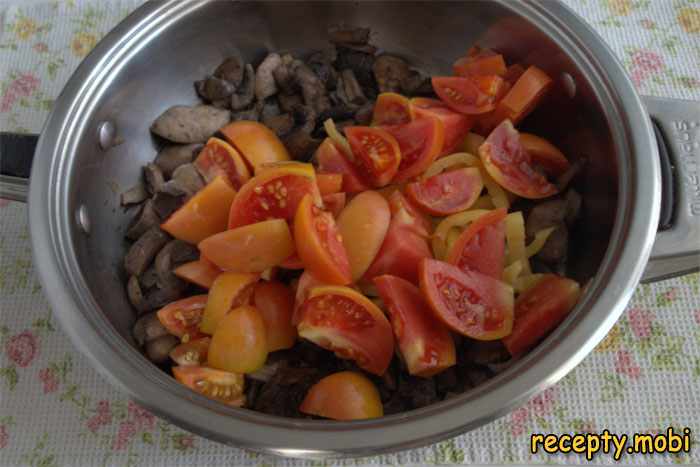
Mix all the ingredients – gently, with a wooden spatula, so as not to break the pieces of tomato and to keep the mushroom "segments" whole.
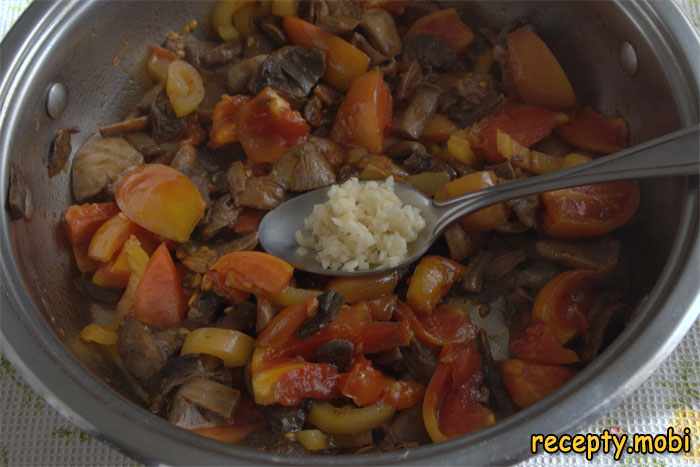
Simmer the fragrant mushroom mixture for 17–20 minutes over medium heat, stirring occasionally with a wooden spatula. The mushrooms should become soft and the tomatoes should turn into a thick sauce. Two or three minutes before the end, add the finely chopped garlic – no earlier, otherwise it will burn and turn bitter. The garlic should only warm through and release its aroma, not fry. Take off the heat and serve at once – the sauté is tastiest hot, while the mushrooms still hold their texture.


Tips
- 1
High heat at the start is the "secret" against mushrooms turning mushy. Champignons are 90% water. Over low heat they drown in their own juices and turn into a boiled mass without their characteristic springiness. Over high heat (with well-heated oil) the water quickly evaporates, the mushrooms turn golden at the edges and stay firm inside. An important point: lay the mushrooms in the pan in a single layer, not piled on top of one another – otherwise the lower layers steam in the water from those above. The same "hard frying versus stewing in juices" principle works in mushroom cutlets from boiled frozen mushrooms.
- 2
Garlic right at the end is the "secret" of aroma. Garlic added at the start or middle of cooking has time to burn over the heat and gives a bitter "scorched" taste. If you add it 2–3 minutes before the end, it only warms through and releases its aroma into the oil and tomatoes without frying. An alternative technique is to grate the garlic finely and add it after taking the pan off the heat (the hot dish "activates" the garlic without scorching). The same "fresh garlic at the finish" principle works in aubergine sauté in a pan.
- 3
Mushrooms of different sizes are the "secret" of an attractive presentation. Small champignons (caps up to 2 cm across) can be left whole – they look attractive in the finished dish, especially once the tomatoes have turned into a sauce. Medium ones I cut in half, large ones into 4–6 segments. "Calibrating" during cooking (frying the small ones first, then the large) is not needed – all sizes work together.
- 4
Variations with other mushrooms are the "secret" of a new flavour with the same technique. Champignons are a "neutral base", but with other mushrooms you get a more distinctive dish. Oyster mushrooms are softer and cook faster (12–15 min). Porcini are more aromatic and need more time (25–30 min). Chanterelles have a bright "forest" character and need to be fried separately before the tomatoes are added (they turn bitter when simmered in sauce). Fresh basil at the end gives a Mediterranean accent. With toasted bread rubbed with garlic, you get an "Italian" bruschetta style.
FAQ
Why do mushrooms release so much water? +
Champignons are 90% water – that is normal biology. When heated, the cell membranes break down and the water is released. To make the water evaporate quickly, cook over high heat in small batches (a single layer in the pan) rather than in a "heap". If you add a lot of mushrooms at once, the lower layers steam in the water from those above and you get no frying. Alternative: fry in batches of 200–300 g, each batch until golden, then combine. Do not cover with a lid – the steam must escape, otherwise the water collects back again.
Can other mushrooms be used? +
Yes – oyster mushrooms (cook faster, 12–15 min), porcini (more aromatic, 25–30 min), orange-cap or birch boletes (dense texture), and chanterelles (a distinctive "forest" flavour, needing pre-frying) all work. Forest mushrooms cook longer than champignons and sometimes need boiling for 5–10 minutes before frying to remove any bitterness. Frozen mushrooms – defrost in a colander and squeeze out before cooking. Dried forest mushrooms – soak for 2 hours in warm water, then slice and fry.
What can replace tomatoes in winter? +
The best replacement is tomatoes canned in their own juice (without tomato paste, without spices) – a 400 g tin. Alternatives: purée of canned tomatoes (a more "saucy" option), sun-dried tomatoes (a richer, more "Mediterranean" note), or 2 tablespoons of tomato paste diluted in 100 ml of water (this gives a "marinade" character – not the classic version). Fresh hothouse tomatoes in winter are a compromise, with little flavour. It is better to freeze summer tomatoes in batches of 300–400 g, so that in winter you can take them as if from your own "home season".
What to serve mushroom sauté with? +
It is a versatile dish. On its own: hot, with a sprig of parsley or basil. Side dishes: mashed potatoes with butter, boiled buckwheat, basmati rice, couscous with herbs, pasta (especially tagliatelle). With bread: toasted baguette with garlic, lavash, toast with melted cheese. As a filling: for a yeast pie, or with mince for a double mushroom-and-meat filling. For breakfast: with an omelette or fried eggs. With drinks: dry red wine (Chianti, Merlot), cold unfiltered lager, black tea with lemon.
- Comment
or post as a guest
Be the first to comment.