avg —
Guryevskaya Kasha

Instructions
I prepare the ingredients. The baked milk can be replaced with an equal mix of regular milk and heavy cream. Any nuts (hazelnuts, almonds, peanuts, pine nuts) and any berries or dried fruit will work for the filling.
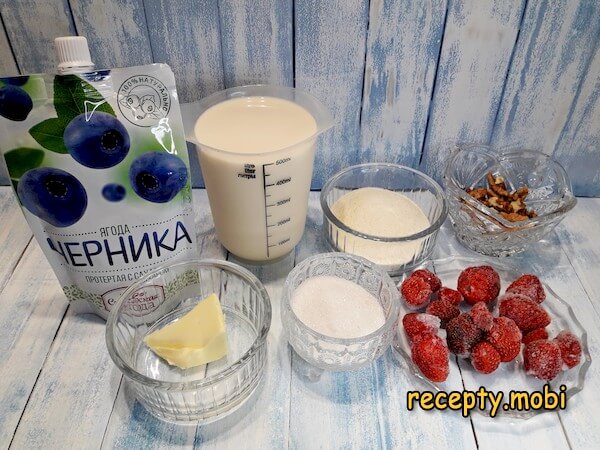
For thick foams it is better to use a pan with a wide bottom, so the area of the finished skin is as large as possible. The pan has to go into the oven, so its handles must not be plastic. Into such a pan, for example a frying pan, I pour 500 millilitres of baked milk. I switch the oven on to 180 degrees and, to speed things up, set the pan of milk on the stove to warm in the meantime.
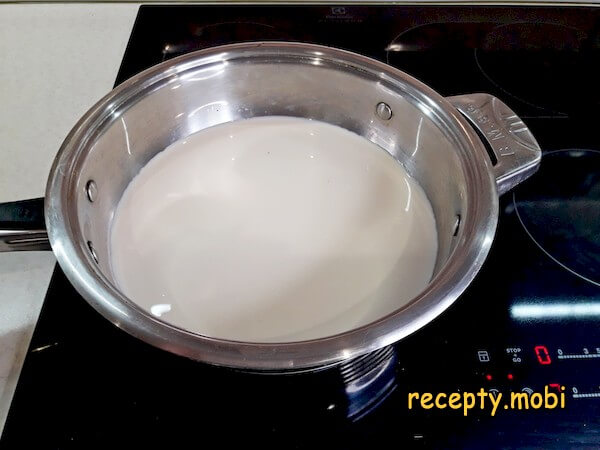
Once the oven has reached the right temperature and the milk is hot, I move the pan into the oven. There the milk will not boil but only gently simmer. Its surface stays still, so a thick skin begins to form — this is the "secret" stage of authentic Guryevskaya kasha.
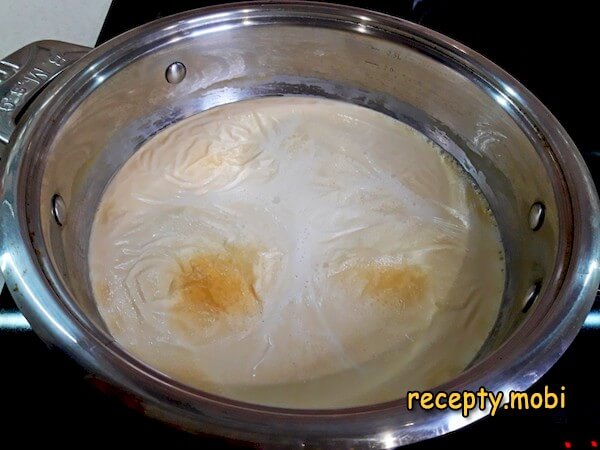
After about 15 minutes I take the pan out of the oven and lift the skin that has formed with a wide spatula or skimmer — a thin skin should come away in one piece without falling apart.
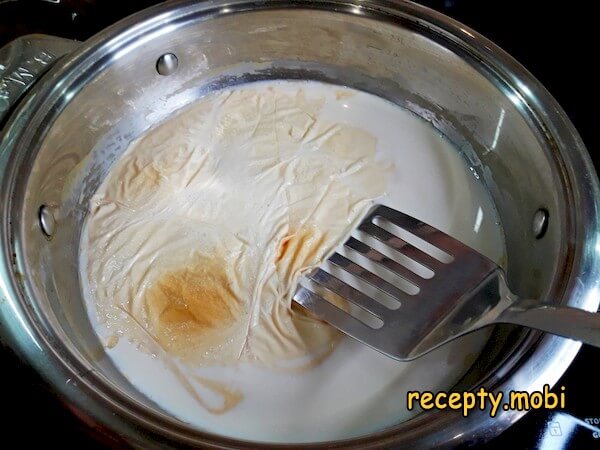
I transfer the first skin to a plate — it will be one of the 4–5 "layers" in the final composition of the kasha.
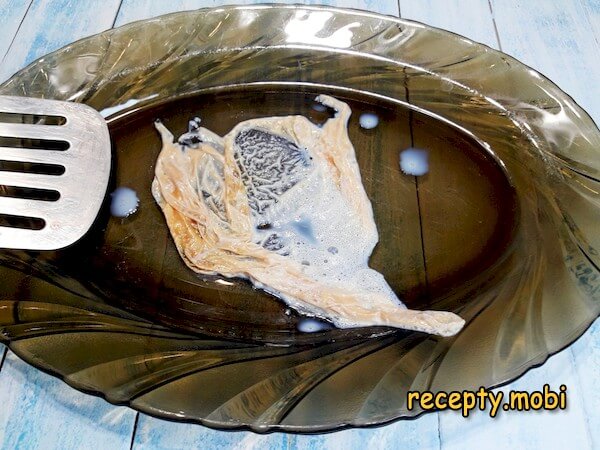
I return the pan to the oven and wait another 15 minutes for the next skin to form. This way I collect 4–5 skins (they can be kept a little longer in the oven so they take on a golden colour). I don't switch the oven off at the end — it will be needed again for the final baking.
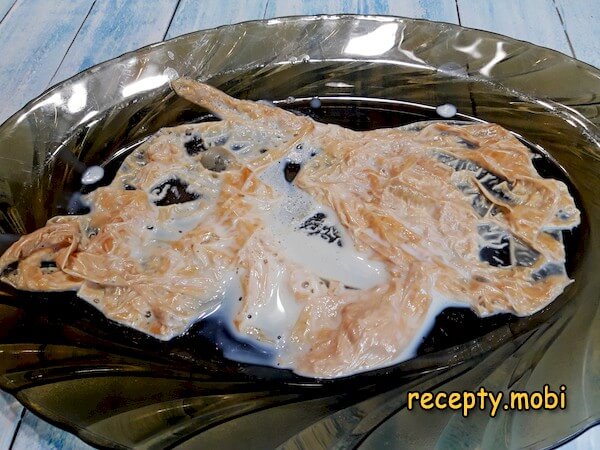
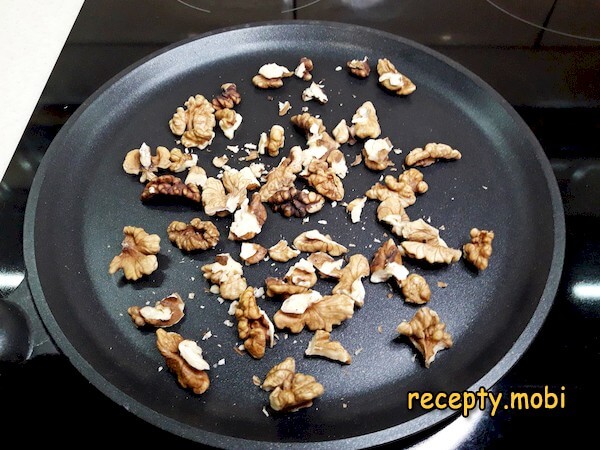
I heat the walnuts in a frying pan until hot — this makes them more brittle and tasty. This is another "secret" of authentic Guryevskaya kasha.
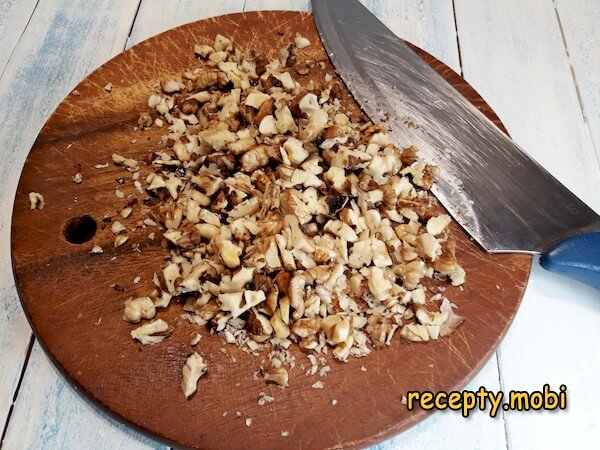
Then I chop the kernels with a knife — with a knife exactly, not a blender. A blender would turn the nuts to dust, but we need recognisable large pieces.
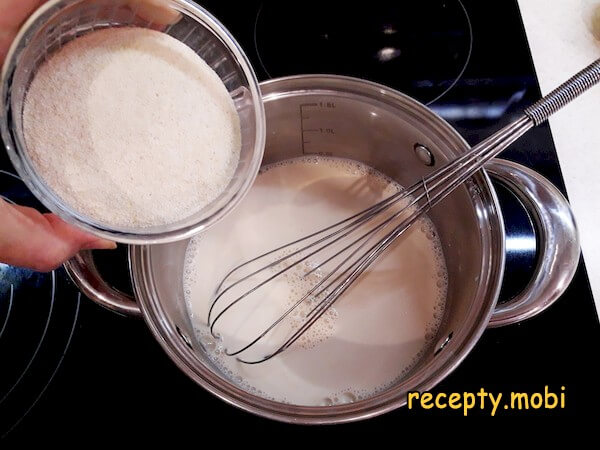
Now I move on to making the semolina porridge itself — it should be thick. I pour the milk left after evaporating the skins into a saucepan and top it up with the missing amount so that I end up with 500 millilitres in total. I set the saucepan over moderate heat and start pouring in the semolina with one hand while whisking the mixture vigorously with the other. This is the "secret" against lumps — a thin stream of semolina with the whisk turning continuously.
The porridge will start to thicken at once. I cook it for 3–4 minutes with the addition of butter — thick, like a pudding, for the layered composition.
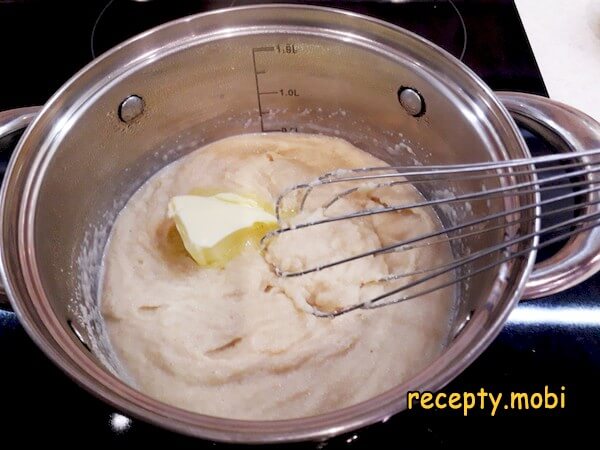
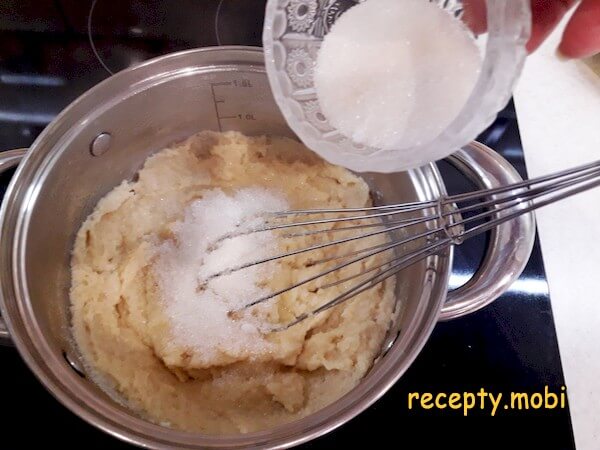
As I go, I sweeten the porridge with sugar — not too much, since there will be jam and sweet skins later on.
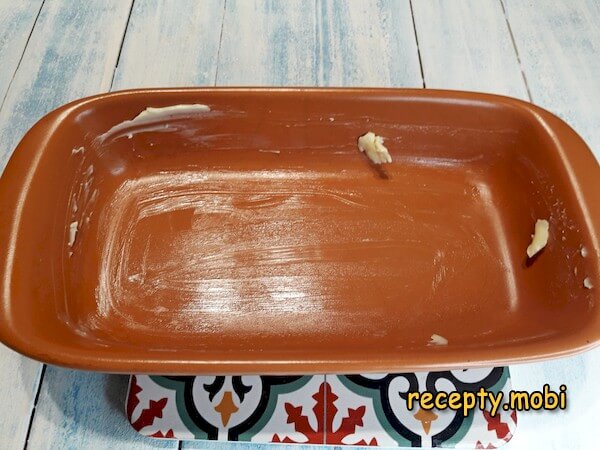
I grease the dish well — so the finished kasha slips out of it easily when serving.
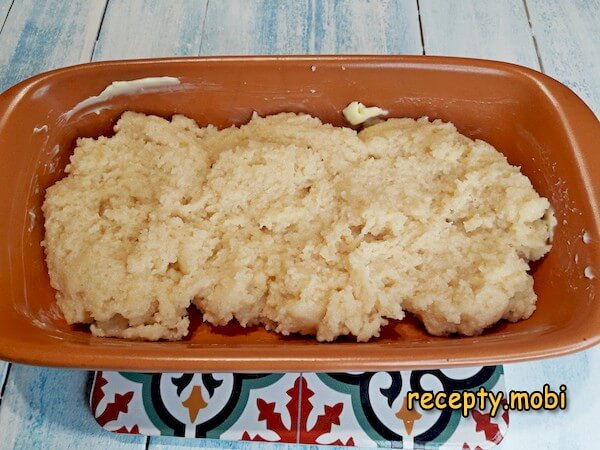
I lay the first layer of semolina into it — an even, dense layer across the bottom of the dish.
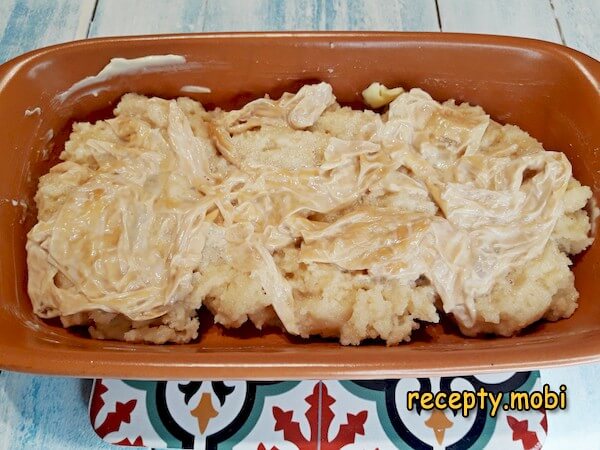
I take half of the prepared skins and spread them on top — the skins "hold" the layers apart so they don't blend into one mass.
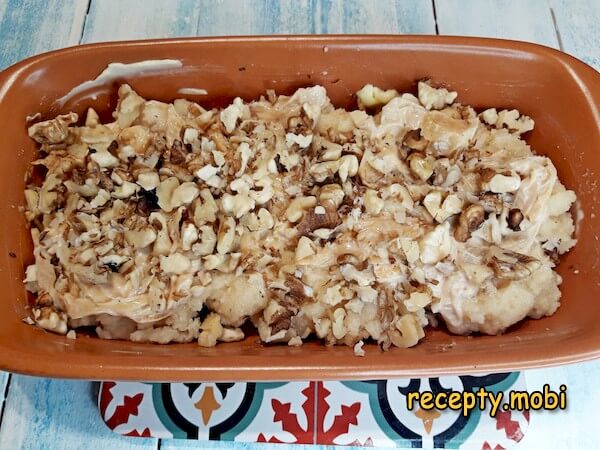
I sprinkle them with nuts — the warm, brittle walnuts give the whole dish its characteristic "Russian" character.
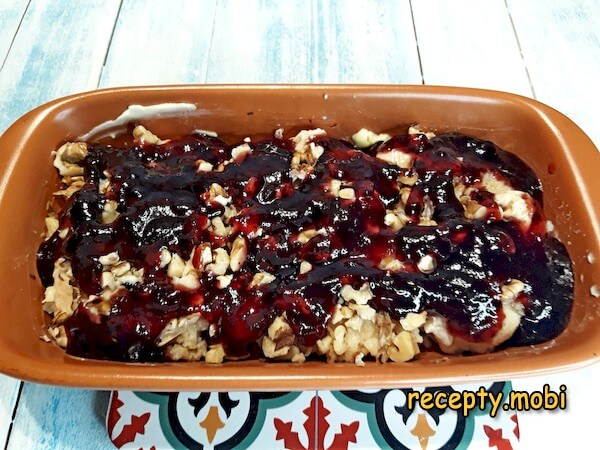
The next layer is berry jam. It is better to use a thick jam that won't run over the nuts and soak into the lower layers.
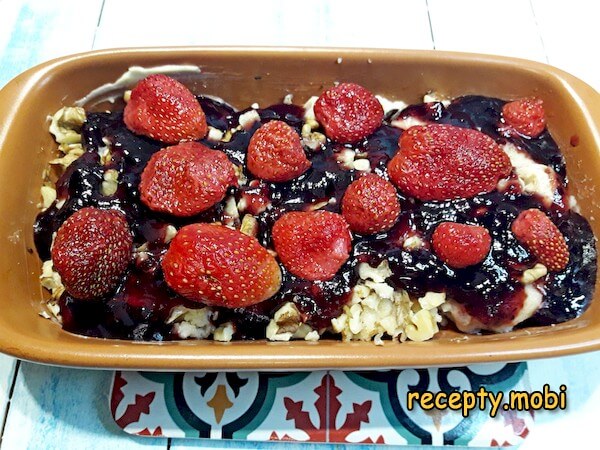
On top of it I lay out the strawberries — fresh or thawed berries add bright fruity notes.
I close everything with a second layer of semolina porridge, which I cover with skins — the two-tier "porridge–berries–porridge–skins" composition is the classic of Guryevskaya presentation.
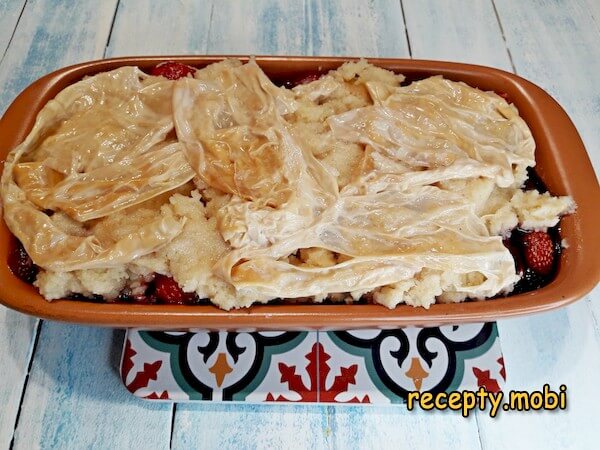
I sprinkle the top with nuts and a pinch of sugar to give the surface a golden colour — the sugar on the skins caramelises in the oven and creates a beautiful "glaze" effect.
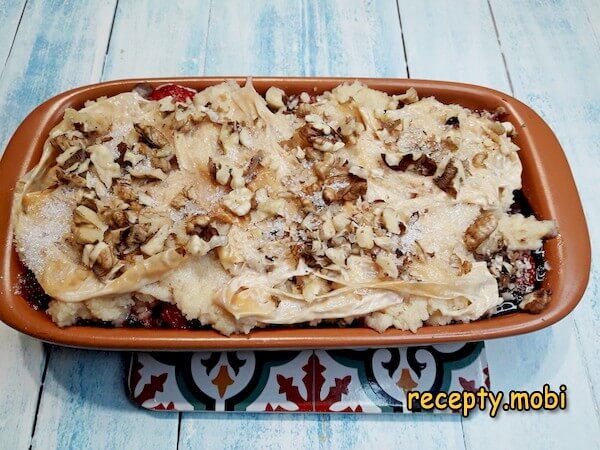
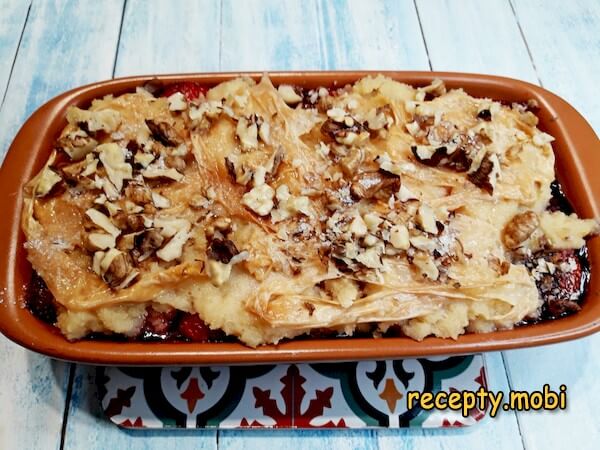
I put the filled dish into the oven (which is still on) for about 5–7 minutes, so the top layer browns — briefly, so the lower skins don't dry out.And there it is — appetising and incredibly tasty Guryevskaya kasha is ready. Ordinary semolina has been wonderfully transformed into a refined dessert that is hugely popular in Russian restaurants. In this kasha the layers don't blend together — they are held in place by the appetising skin of evaporated milk. Such a dessert can make an excellent breakfast, and to cut down on the morning preparation time, the skins are made the day before and kept in the fridge.


Tips
- 1
4–5 SKINS — the "secret" of an aristocratic presentation. Guryevskaya kasha is not "ordinary semolina" but a "layered dessert". The key to it is precisely the baked-milk skins, which hold the layers together and give it its characteristic aroma. 4–5 skins is the minimum for a beautiful composition; 6–7 is premium. Fewer skins mean there is no visual "layered" effect, and not the same authenticity.
- 2
BAKED MILK IS A MUST — the "secret" of the aroma. With ordinary milk, Guryevskaya kasha turns out "bland", without the characteristic "golden" tint and aroma. Baked milk (or its substitute: milk + heavy cream 1:1) gives that "rustic" note associated with old Russian cuisine. This is the "secret" from Count Guryev, who gave the dish its name.
- 3
MAKING THE SKINS THE DAY BEFORE — the "secret" of convenient preparation. An hour and a half of active work for a single breakfast is a long time. The skins can be made the evening before and kept on a saucer under cling film in the fridge for up to 24 hours. In the morning all that's left is to cook the semolina and assemble the layers — the dish is ready in 20 minutes instead of an hour and a half. This is the "secret" of convenience from restaurant chefs.
- 4
UNIVERSAL GRAIN AND FRUIT — the "secret" of seasonal variations. Using the Guryevskaya kasha technique you can make versions with different grains and fillings. Following the principle of millet porridge with pumpkin in milk — an "autumn" version with pumpkin, cinnamon and dried fruit. Or pumpkin porridge with rice in milk as a "children's" variation without the complicated skins.
FAQ
Where does the name "Guryevskaya" kasha come from? +
Guryevskaya kasha is named after Count Dmitry Guryev — Minister of Finance of the Russian Empire from 1810 to 1825. According to legend, Count Guryev tasted this kasha at the home of an acquaintance, the landowner Yurisovsky, in the early 19th century. Guryev liked the recipe so much that he bought from Yurisovsky the serf cook Zakhar Kuzmin — the author of the recipe. After that, Guryev began treating all his noble guests to the kasha at his home, and the name "Guryevskaya" stayed with the dish forever. Today it is one of the most famous dishes of classic Russian restaurant cuisine.
Can semolina be replaced with another grain? +
Technically yes, but then it will no longer be "Guryevskaya" kasha. Semolina is a mandatory component, giving the layers their "delicate pudding" texture. Alternatives for "author's" versions: finely ground oat flakes (which give a more "rustic" texture) or rice flour (an unusual "gluten-free" option). Buckwheat or millet are not suitable — the structure of the kasha would be too coarse for the thin layers with skins. In the original recipe it is specifically semolina — a classic that is not to be broken.
How long does the finished Guryevskaya kasha keep? +
In the fridge in an airtight container — up to 2 days. After a day the layers partly soak into each other and the clarity of the composition is lost. Before serving I reheat it in the oven at 100 °C under foil for 8–10 minutes — a microwave makes the skins "rubbery". I don't recommend freezing it — after thawing, the texture of the kasha becomes watery and the berries and skins fall apart. It is better to make it right before serving, or at most a day ahead. Preparing the skins in advance is fine — up to 2 days in the fridge.
What to serve Guryevskaya kasha with? +
The classic Russian way to serve it is in the individual ceramic or glass dish it was baked in. On the table: a small bowl of extra jam or honey for added sweetness, a spoonful of fresh berries on top for contrast with the warm kasha, and a sprig of mint as decoration. For drinks: hot black tea with lemon, cocoa with milk, or traditional Russian sbiten; for the dessert table — dessert wine or liqueur. As a sweet breakfast for children: with hot cocoa and rusks. For a Sunday supper: as a dessert in its own right after a light main course.
- Comment
or post as a guest
Be the first to comment.