avg —
Yogurt-Based Pizza Dough Without Yeast

Instructions
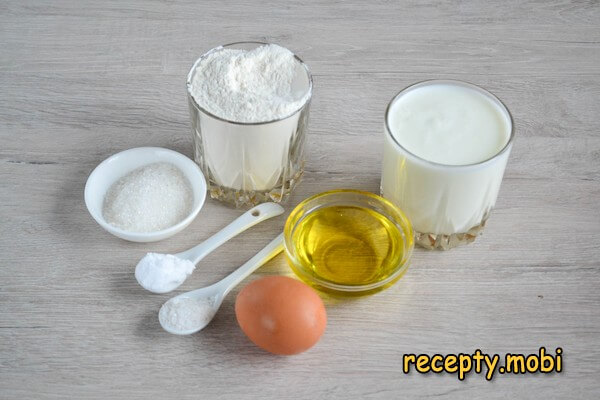
Prepare all the ingredients needed for the yeast-free kefir dough. You can use kefir of any fat content – mine is 1%. If you use a fattier one, it will be thicker and you will need less flour. The amount of flour given makes quite a lot of dough – enough for 2 pizzas 32 cm across.
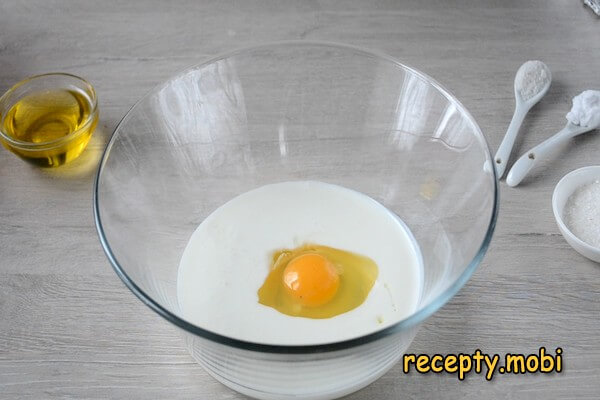
Pour room-temperature kefir into a large bowl. Add the egg and stir.
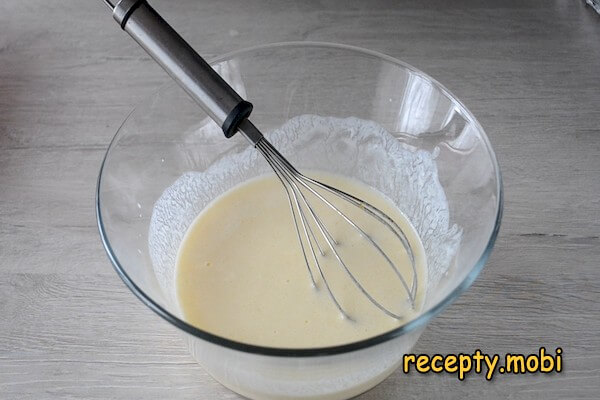
Add the soda, salt and sugar, stir, and pour in the vegetable oil.
Sift the flour into the dough (better several times, to saturate the dough with as much air as possible) and knead the dough. First mix with a whisk, then transfer it to a work surface and knead by hand. Dust with flour from time to time so the dough does not stick to your hands. At the same time, try not to weigh the dough down with too much flour. Knead for at least 10 minutes.
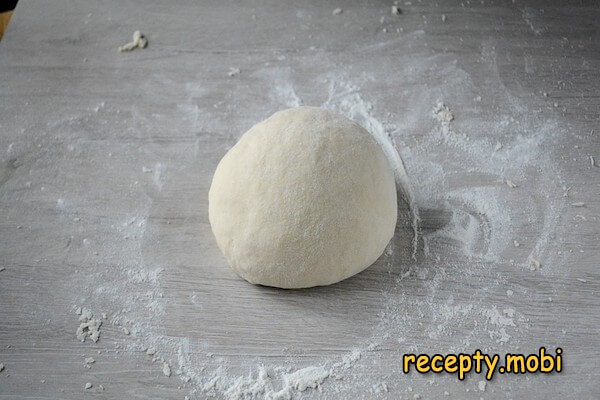
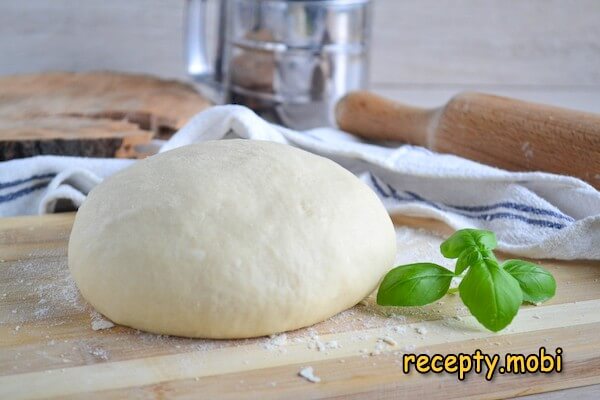
This is how soft and tender the yeast-free kefir pizza dough turns out. Well kneaded, it holds its shape. The dough is ready for making the pizza.Enjoy your meal!


Tips
- 1
ROOM-TEMPERATURE KEFIR is a must. Cold kefir will "slow down" the soda reaction and the dough will be "dense".
- 2
SIFT THE FLOUR TWICE – the air in the dough gives it porosity. Without sifting, the dough will turn out "heavy".
- 3
10 MINUTES OF KNEADING is a must. In less time the gluten will not "work" and the dough will crumble.
- 4
ADD THE FLOUR GRADUALLY – the dough should not be "weighed down" with too much flour. The same principle works with other kinds of yeast-free dough.
Video
FAQ
Which kefir should you choose? +
Fresh kefir of 1-3.2% fat is ideal. A fatty one (3.2%) gives a softer dough, a low-fat one (1%) a "lighter" dough. The shelf life should not have expired. Old, "slightly soured" kefir is even better – it reacts more actively with the soda. Alternatives: soured milk, ryazhenka (a more "intense" flavour), ayran (salty, for savoury buns), whey (a "lighter" dough). For vegans, use soy kefir. A cultured-dairy base plus soda equals a fluffy, porous yeast-free dough in 15 minutes.
What can you make from this dough? +
A versatile yeast-free dough: pizza (a classic base), baked pies with any filling, chebureki, flatbreads in a pan, Caucasian khychiny, focaccia, langosh (a Hungarian snack), Imeretian khachapuri. For frying – chebureki, deep-fried pies. For baking – pizza, open pies, flatbreads. For a sweet version, add 2 tablespoons of sugar and vanilla. For a savoury one, reduce the sugar to 1 teaspoon. The dough is good for a "quick dinner". In the fridge this dough can "wait" for 12 hours under cling film.
How long does the dough keep? +
In the fridge in cling film or a container – up to 24 hours. I do not recommend longer, as the soda "loses its strength" and the dough loses its fluffiness. Before using, let it stand for 30 minutes at room temperature. In the freezer – up to 1 month in portions (in cling film). Defrost in the fridge for 4-6 hours, then 30 minutes on the counter. After defrosting, use it straight away. A ready-rolled base is frozen separately with parchment between the layers. Dough kept in the fridge for 2-3 hours rolls out more easily – "cold" dough is more "obedient".
Which fillings does it go with? +
Versatile for any filling: Hawaiian, Margherita, Pepperoni, Four Cheeses, Prosciutto, Diavola. For savoury baking: with cabbage and egg, with mushrooms and onion, with potato and cheese, with meat and onion (like chebureki). For sweet ones – with cottage cheese, with apples and cinnamon, with cherries. For khychiny flatbreads – with cheese and herbs. Standard dough thickness: for pizza – 3-5 mm, for pies – 5-7 mm, for flatbreads – 8-10 mm. A ratio of 200 g of dough to 100-150 g of filling is ideal.
- Comment
or post as a guest
Be the first to comment.