Salt Dough for Sculpting for Children
Salt dough is a safe, non-toxic modelling material that kids love, and you can make it at home from just flour, salt, and water. The classic ratio is 2 parts flour to 1 part fine salt, with the water added little by little as you knead until the dough is smooth, pliable, and holds its shape. Below I'll show you how to mix the perfect batch, colour it with food dye or paint, and dry your creations either in a low 50 °C oven or simply air-dried overnight to prevent cracking. Finished figures and ornaments can be painted, sealed with clear varnish, and kept for years, making this a perfect rainy-day craft for toddlers and older children alike.
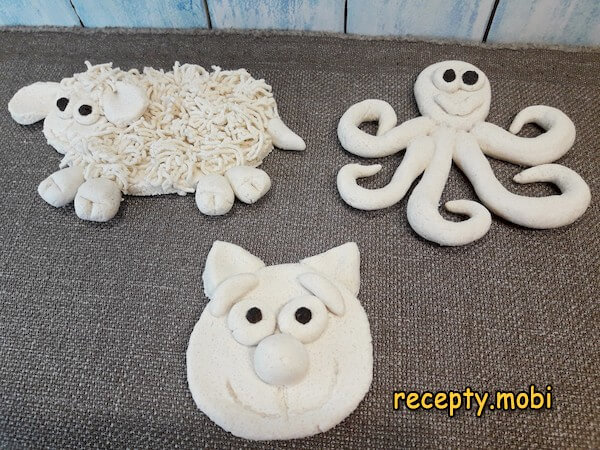
I make salt dough for sculpting as a creative activity to do together with my child. The finished material is completely safe, as it is made only from flour, salt, and water. It is a pleasure to work with: very supple, pliable, and it doesn't stain your hands. You can model absolutely anything from it – from flat figures and picture scenes to large three-dimensional pieces.
At the end, the figures are dried on a radiator, simply in the sun (for flat pieces), or placed in the oven and dried at a minimum temperature (around 50 degrees) over a long period. If you like, the pieces can be painted with any paints and then coated with varnish. Sculpting with salt dough is a very absorbing process that children of any age enjoy.
Preparation step by step
- salt dough;
- a little water (it is needed for sticking the parts together);
- a few black peppercorns (if you are making eyes);
- a garlic press;
- a rolling pin for rolling out.
Tips and Tricks
Tip 1. The 2:1 ratio is the "secret" to the right consistency. Use 1/2 part salt to 1 part flour. More salt and the dough crumbles; less and it is soft and won't hold its shape.
Tip 2. Water a little at a time is the "secret" to pliability. Pouring in all the water at once gives a runny dough. Adding it gradually lets you find the ideal consistency.
Tip 3. A bag against drying out is the "secret" to working comfortably. Exposed dough dries out within 10 minutes. In a bag it stays fresh for hours – handy for a long sculpting session with a child.
Tip 4. Water for sticking is the "secret" to strength. Dry parts will fall off. A wet brush dipped in water glues the parts firmly together as they dry. The same principle applies to other kinds of homemade dough for crafts.
FAQ
Which flour should I choose?+
Plain white wheat flour of the highest grade (any baking flour) is ideal. Alternatives include grade 1 flour (darker and coarser), or a mix of white flour and starch in an 80/20 ratio for a smoother texture. Fresh flour with no lumps gives the best result. Avoid self-raising flour with a raising agent, as the dough will bubble during drying, and avoid gluten-free blends, which sculpt poorly. For classic salt dough, plain wheat flour of the highest grade is essential.
Which salt should I use?+
Fine "Extra" salt is ideal, as it dissolves in the water and leaves no grains behind. Alternatives include medium-ground table salt (grind it in a coffee grinder for smoothness) or fine sea salt. Iodised salt makes no difference to the sculpting. Coarse children's salt is not suitable, as the large grains show up in the dough. Avoid coarse rock salt, which won't dissolve and leaves the dough gritty, and avoid seasoned salt blends with spices. For the classic version, fine "Extra" salt is essential.
How do I dry the finished figures?+
Air-drying at room temperature is ideal – 24–48 hours for flat figures, or 3–4 days for three-dimensional ones. To speed things up, use a radiator for 5–6 hours (flat pieces), an oven at 50–60 °C for 2–3 hours (with the door left slightly ajar), or sunshine in summer for one day. Avoid the microwave, which makes the dough crack, and temperatures above 80 °C, which darken and crack it. After it is fully dry, a coat of varnish (any clear kind) protects the piece for years. You can paint it with gouache, watercolour, acrylic, or nail polish before applying the final coat of varnish.
What can I use to paint the finished figures?+
The classic choice for children's crafts is brightly coloured gouache (it dries quickly and doesn't run). Alternatives include watercolour paints (soft shades), acrylic paints (durable and fade-resistant), food colourings (for an edible look), nail polish (for unusual effects such as glitter or pearl), water-based felt-tip pens (for small details), and markers (for outlines). For a neat finish, apply a coat of clear varnish (acrylic or furniture varnish). Apply paint only after the dough is fully dry (24+ hours). Spray paints should be used by adults only, in a well-ventilated room.