avg —
Dough for Chebureki with Vodka

Instructions
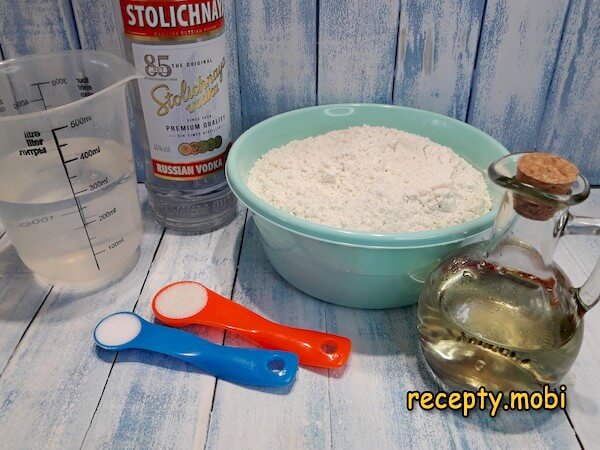
I prepare the ingredients. Instead of vodka you can use any 40-proof alcohol. The flour is best sifted twice, so that it is better saturated with oxygen. For this reason it should be passed through a sieve once before you start and a second time during the kneading.
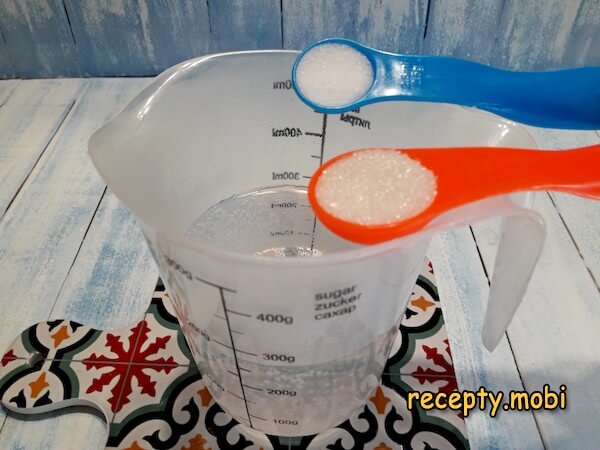
I heat the water almost to boiling (80–90 degrees) and dissolve the salt and sugar in it – it is precisely the hot water that gives the "scalded" effect and elasticity.
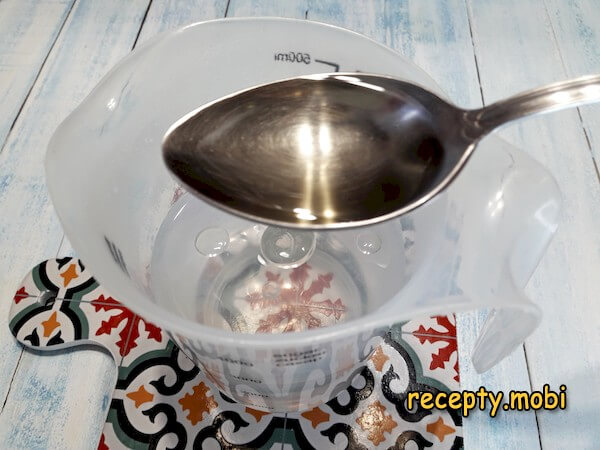
I add the vegetable oil – it makes the dough more pliable and protects it from sticking when rolled out.
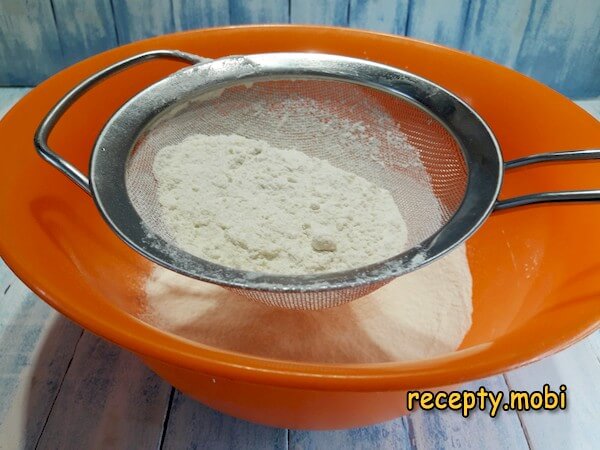
I sift 200 grams of flour into a bowl – it is precisely the split mix (200+300) that gives the optimal structure.
I make a well in it and pour in the hot solution – the classic "well" technique for kneading dough.
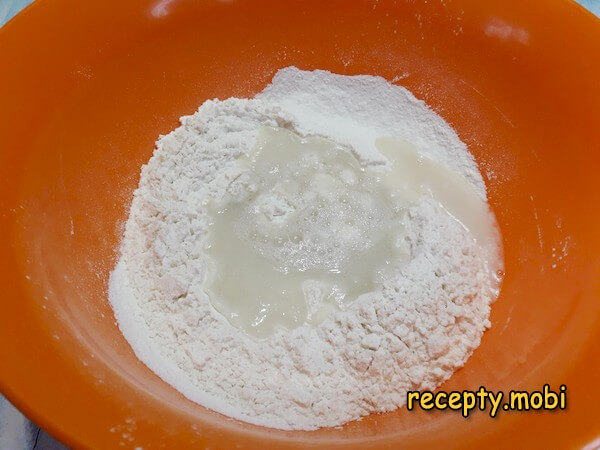
Since the mixture is very hot, I stir it with a spoon – not by hand, so as not to get burnt. The result will be a sticky, lumpy mass.
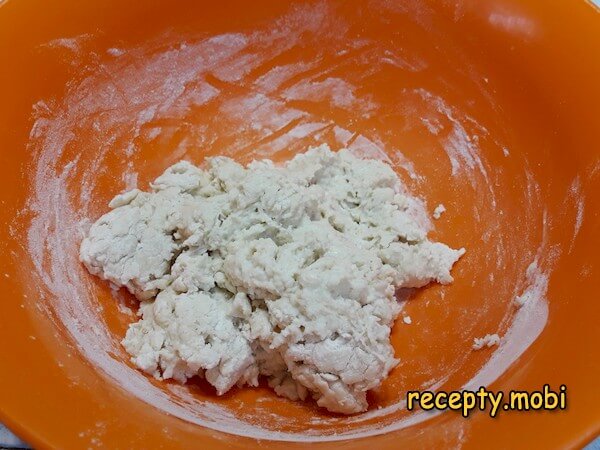
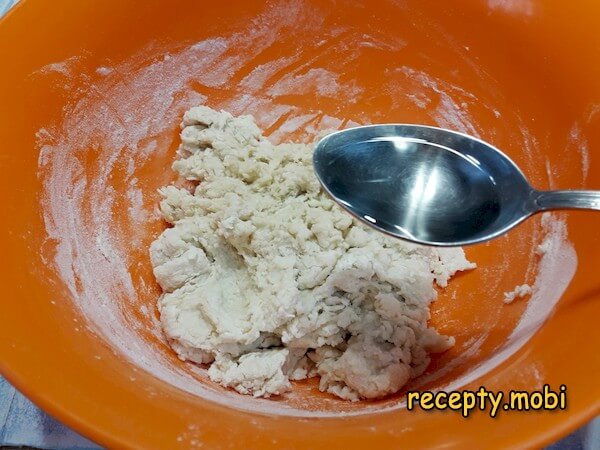
I add the vodka to it – right now, at the end, once the mass has cooled. Otherwise the alcohol will evaporate at once and won't give the "bubble" effect during frying.
And I sift the remaining 300 grams of flour in here too – this is the "second portion" for the final structure.
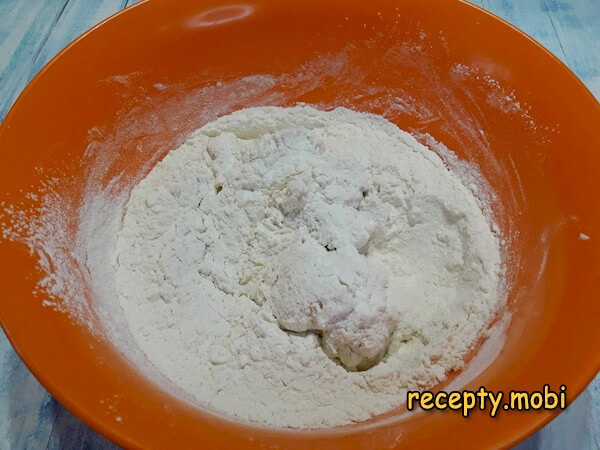
Now I knead the dough by hand. It is pleasant to work with – warm, supple and very elastic. This takes very little time – about 3–4 minutes. At the end I shape it into a ball.
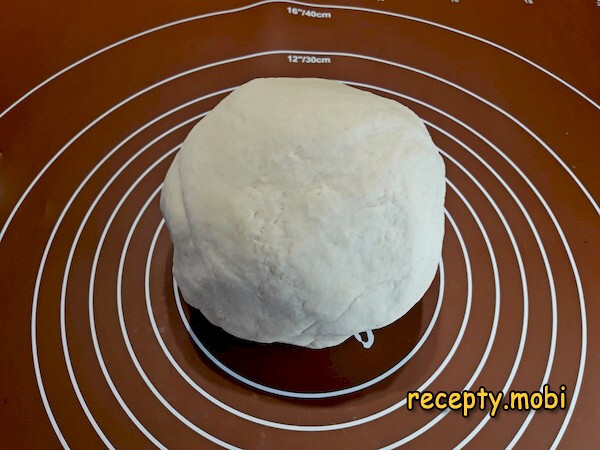
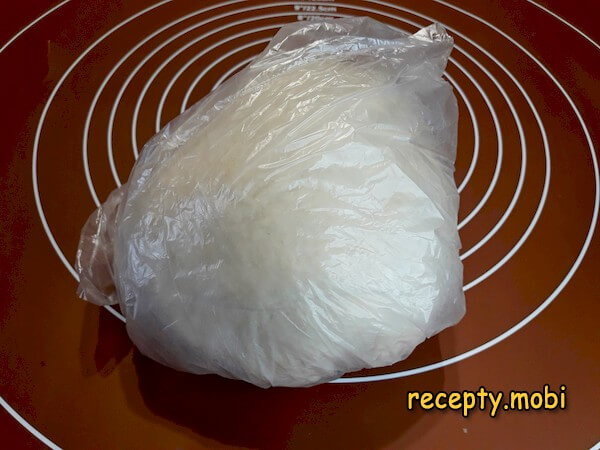
I place it in a bag and leave it on the counter to rest – 30 minutes will let the gluten relax, and the dough will be easier to roll out.
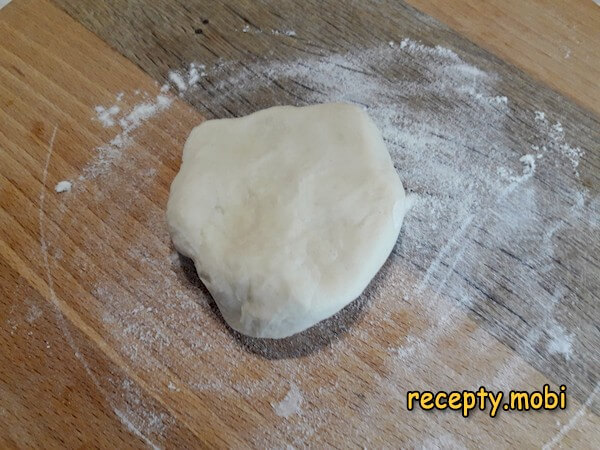
After half an hour I pinch off a small piece of the dough, flatten it, and place it on a surface dusted with flour.
I roll out a round (approximate diameter 20 centimetres) – with even movements from the centre to the edges.
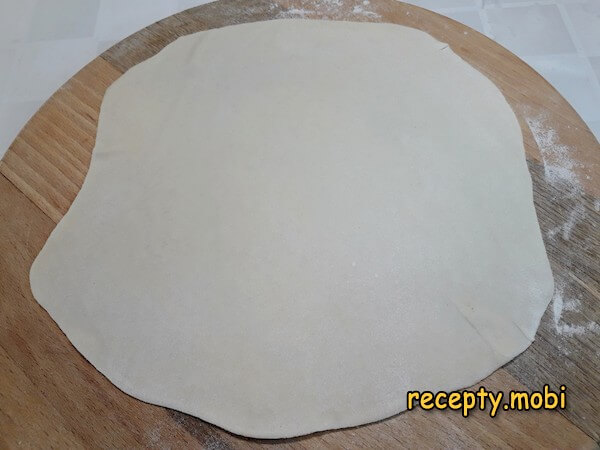
It should be very thin, 1–1.5 millimetres thick – it is precisely the thinness that gives the finished cheburek its bubbliness.
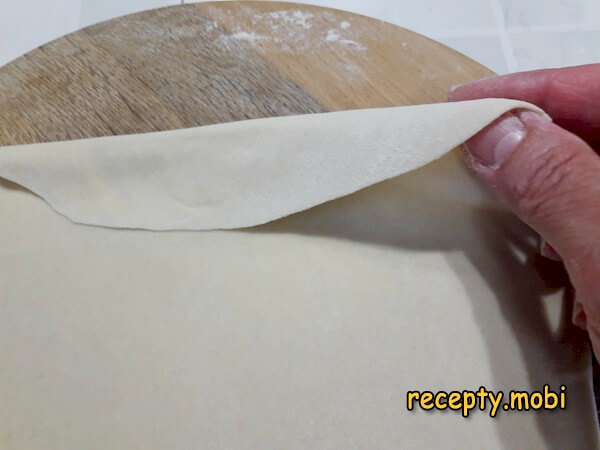
On one half of the round I spread a not-too-thick layer of filling – no more than a 5 mm layer, otherwise the cheburek won't cook through evenly.
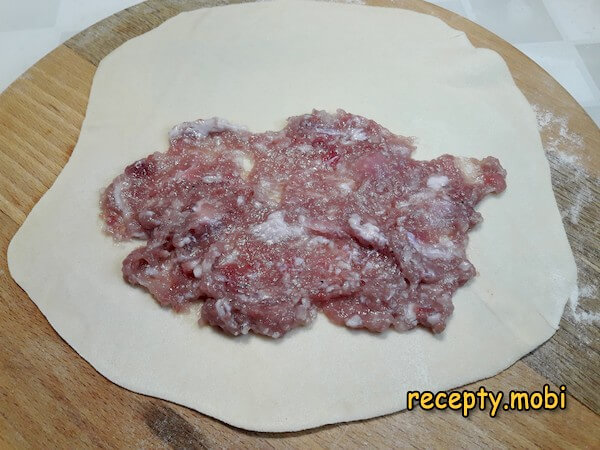
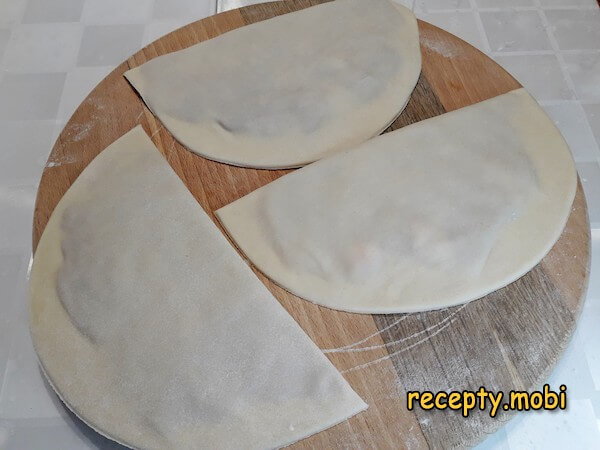
I cover it with the empty half of the round (to make the seal more secure, the inner edge can be lightly moistened with water). With my palms I carefully press down the piece, driving out the air – air bubbles inside the cheburek will burst during frying.
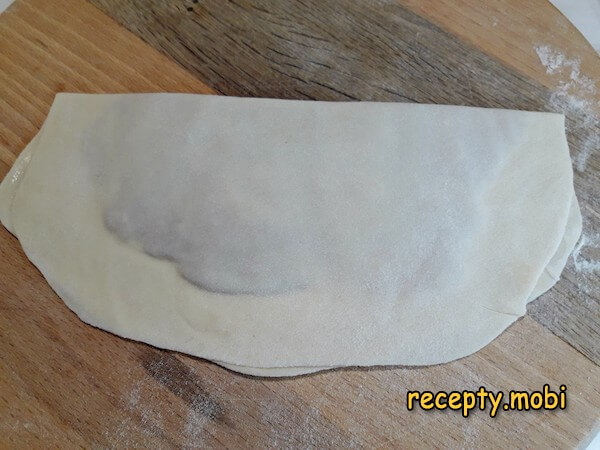
I trim the edge of the cheburek with a saucer – this is the most reliable way to seal it tightly. I add the trimmed strip to the next round to be rolled out, and so on.
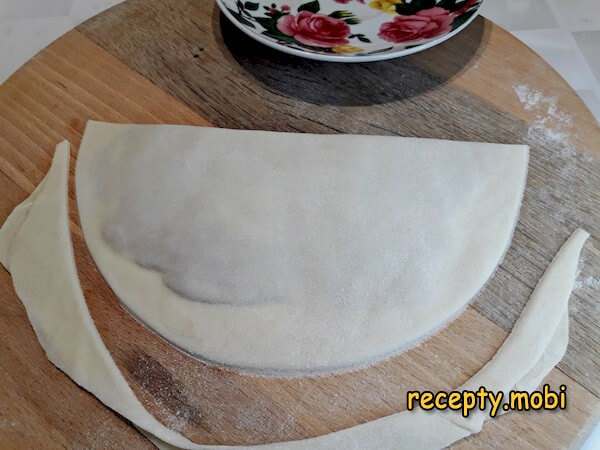
While the oil heats up in a cauldron (it is better to use a pot of small diameter, as a great deal of oil is used), I prepare several pieces for deep-frying.
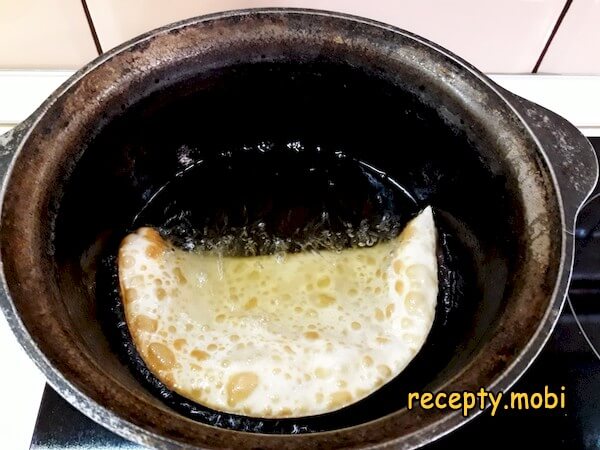
I lower the cheburek into the scorching-hot oil for about 2 minutes (heat on maximum) – the cheburek should "float", not lie on the bottom.
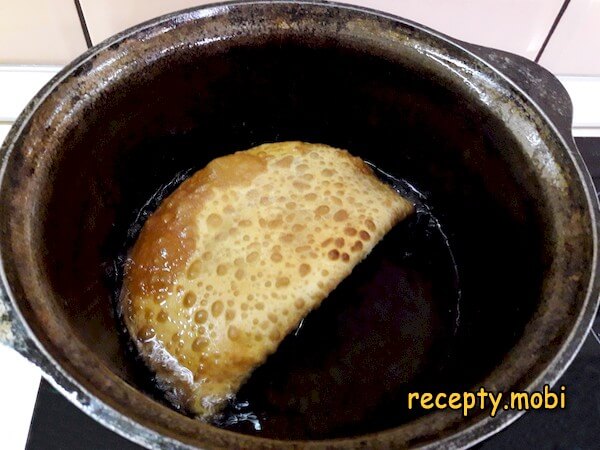
I turn it onto the other side and fry it for another 1–2 minutes on this side – there should be an even golden crust on both sides.
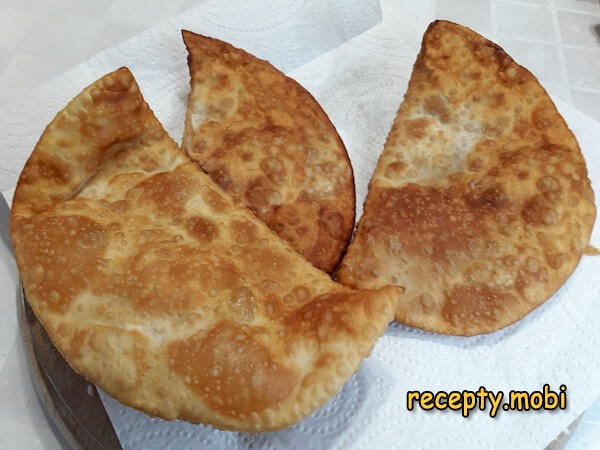
I place the finished chebureki on a paper towel, which will absorb the surface fat – an obligatory finish, so that the cheburek isn't greasy on the outside.The cheburek dough made this way doesn't all have to be used at once. It may be kept in the fridge in a bag for 2–3 days without losing its main qualities. Before rolling out, the piece will need to be kneaded again with a small amount of flour added, as the dough becomes a little damp. And then, at the right moment, juicy and golden chebureki with a bubbly, flaky crust will be ready in a matter of minutes.


Tips
- 1
VODKA AT THE END OF KNEADING – the "secret" of the bubbly crust. If you add the vodka to the hot mix straight away, the alcohol will evaporate in an instant. The aim is for the alcohol to stay in the dough until frying, and only there, at 180–190 °C, to evaporate instantly and form bubbles. So: first the hot water with flour (the scalding stage), then the cooling of the mass, and only then 1 tbsp of vodka plus the rest of the flour. Alternatives to vodka: brandy, rum, pure medical spirit 96% (1 tsp) – the main thing is 40% and above.
- 2
THE SCALDING STAGE – the "secret" of the dough's elasticity. Hot water (80–90 °C) partly "scalds" the starch in the flour, making the gluten more pliable. This is exactly the effect that lets the dough stretch into a thin round of 1–1.5 mm without tearing. Cold water gives an ordinary "stiff" dough that will tear when rolled thin. This "scalding principle" is described in detail in the recipe for chebureki made with scalded (choux) dough – it uses the same basic effect, but without alcohol.
- 3
A THICKNESS OF 1–1.5 MM – the "secret" of the characteristic "blisters". During frying, thin dough heats up instantly to the evaporation temperature of the water and vodka inside. The steam expands tenfold and "inflates" the walls of the cheburek like a balloon. Thick dough (3 mm and more) won't give this effect – the steam doesn't have time to "build up" under the firm crust. The rolling-out is the critical moment: thinner = bubblier, thicker = denser. An alternative alcohol-free version with thin rolling is cheburek dough without eggs.
- 4
"FLOATING" IN THE OIL – the "secret" of even frying. The cheburek should float completely in the oil, without touching the bottom of the cauldron. Only then does the steam inside expand freely, the crust bubbles on all sides, and the filling heats evenly. A minimum of 5–7 cm of oil in the pot, at a temperature of 180–190 °C (to check, a dropped piece of dough rises straight away with bubbles). A narrow cauldron saves oil but means frying the chebureki one at a time. After frying – always a paper towel, otherwise the cheburek will be greasy.
FAQ
What can I use instead of vodka in the dough, if I don't have any at home? +
The vodka can be replaced with any 40-percent alcohol that doesn't have a strong smell: brandy (it gives a faint vanilla-woody note, imperceptible in the finished cheburek), white rum (neutral), gin (with its juniper aroma – an acquired taste), or pure medical spirit 96% in a quantity of 1 tsp. Sweet alcoholic drinks (liqueurs, cordials) won't do – the sugar will disrupt the dough's structure. Beer or wine are absolutely out of the question – their strength of 5–12% is not enough for the bubble effect during frying.
How long does the finished dough keep, and can it be frozen? +
In the fridge in a sealed bag – 2–3 days without losing its elasticity and bubble potential. Before use, the dough needs to be "kneaded again" with 1–2 tbsp of flour added, to remove the excess moisture from condensation. In the freezer – up to 1 month, divided into portion-sized balls and each wrapped in cling film. It must be thawed at room temperature (4–6 hours), not in the microwave. After thawing – knead again with flour too. Chebureki from frozen dough come out a little less "bubbly", but still excellent.
What oil temperature is needed for frying chebureki? +
Ideally 180–190 °C. By eye: a dropped piece of dough should rise straight away with lively bubbles around it. If the dough sinks to the bottom – the oil is cold, the cheburek will soak up fat and be heavy. If the dough darkens within 5 seconds – the oil is overheated, the crust will burn on the outside while the filling stays raw. With a thermometer – check before each batch, especially when frying several in a row (the oil cools down). The heat is adjusted as you go – on maximum when you lower the cheburek in, then turned down a little.
What to serve chebureki with? +
The Tatar and Crimean classics – with hot beef or lamb broth (served separately), pickled onion (thinly sliced onion in vinegar with a pinch of sugar for 5 minutes), and fresh herbs (coriander, parsley, dill). Sauces: sour cream and garlic (with dill), ketchup with hot pepper, adjika, tomato sauce with basil. To drink: black or green tea (hot, as in Crimea), ayran, tan, homemade kvass. As an accompaniment to the chebureki: a light salad of tomatoes and cucumbers, pickled gherkins or cabbage.
- Comment
or post as a guest
Be the first to comment.