avg —
Cottage Cheese Blancmange

Instructions
I prepare the listed ingredients for cottage cheese blancmange. For flavouring it is better to use vanillin or a liquid essence rather than vanilla sugar, since the sugar granules will stay undissolved and spoil the smooth texture of the dessert.
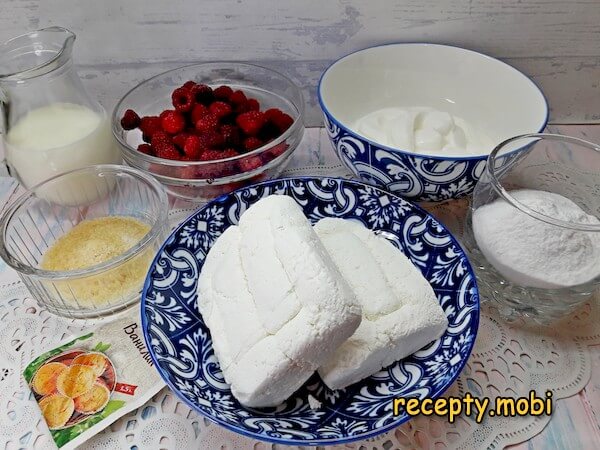
I put the gelatin into the milk and let it swell for now.

If the cottage cheese has a paste-like consistency with no grains, you can combine it with the sour cream straight away. A grainy cottage cheese should first be passed through a sieve.
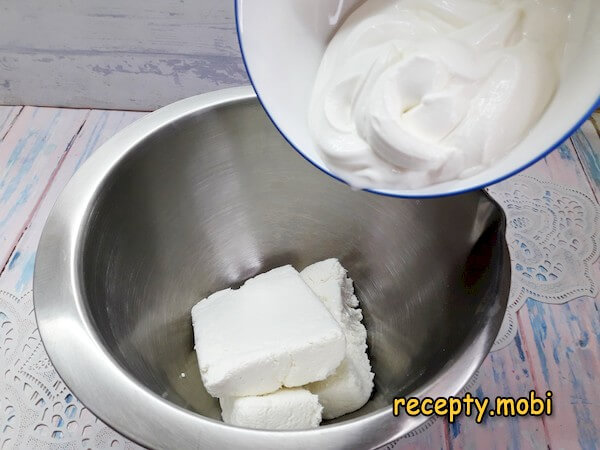
I add the powdered sugar.
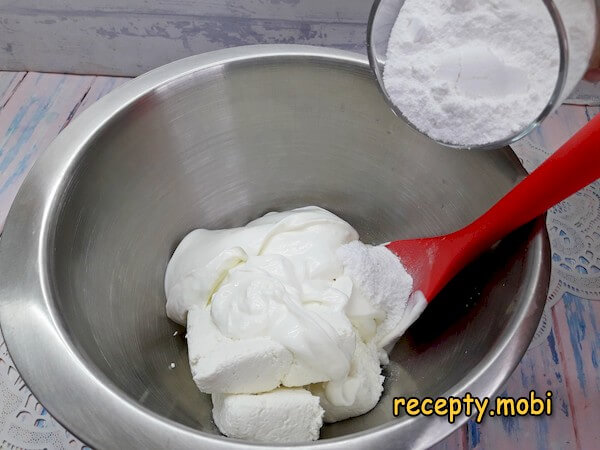
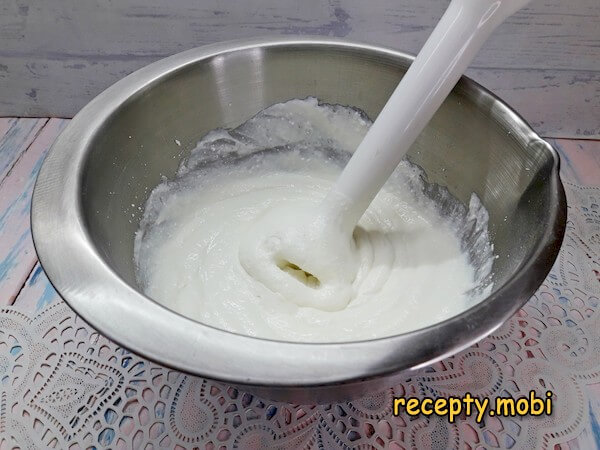
With a blender I bring the mixture together into a single whole, achieving complete uniformity.
I heat the milk with gelatin without bringing it to a boil (this is convenient to do in the microwave, set to maximum power and checking the temperature every 30 seconds). It is possible that even after this not all of the gelatin will have fully dissolved. So, to be safe, I blend the mixture again with an immersion blender so that no undissolved particles remain.
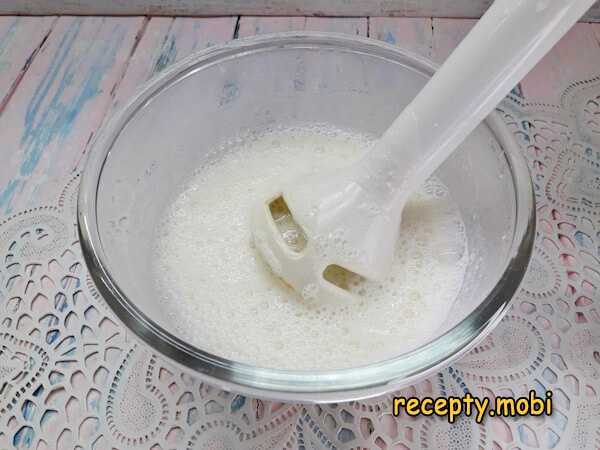
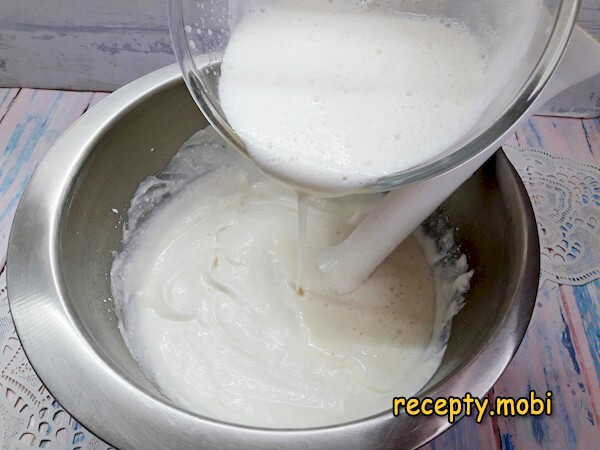
I wait until the temperature of this milk mixture has evened out to room temperature, after which it can be added to the cottage cheese and sour cream mixture. Again I use the blender, simply stirring the resulting mixture.
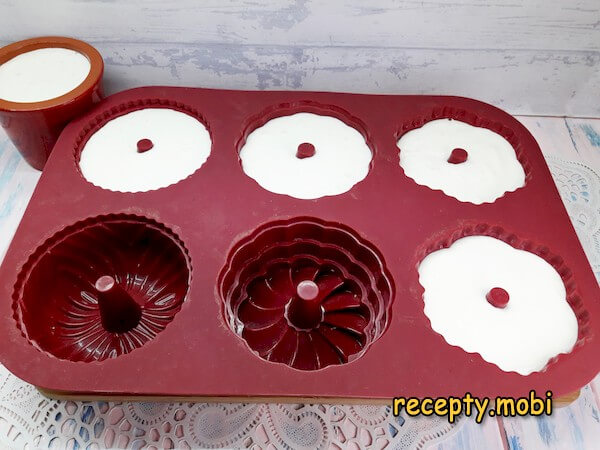
I prepare the moulds for filling. Silicone containers are very good for this dessert – they do not need to be greased with anything and the contents come out perfectly after a light push on the bottom. Ordinary cups and bowls will also do. The main thing is that their outer diameter should not be smaller than the inner one, otherwise it will be impossible to remove the dessert. Such containers also do not need to be oiled – after a brief dip in boiling water the cottage cheese dessert slides out of the mould without any trouble. I pour the mixture into the containers, stopping 5–7 millimetres short of the rim.
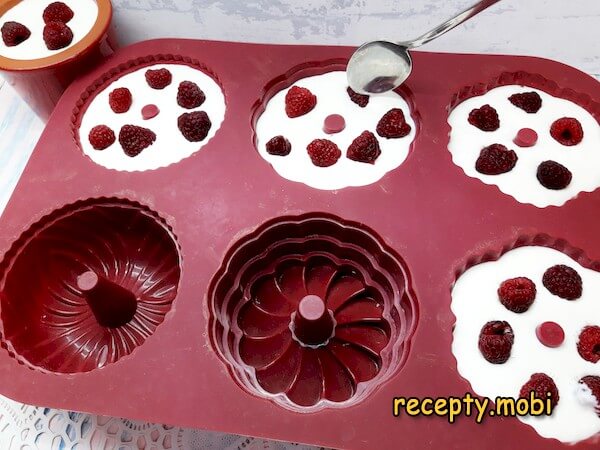
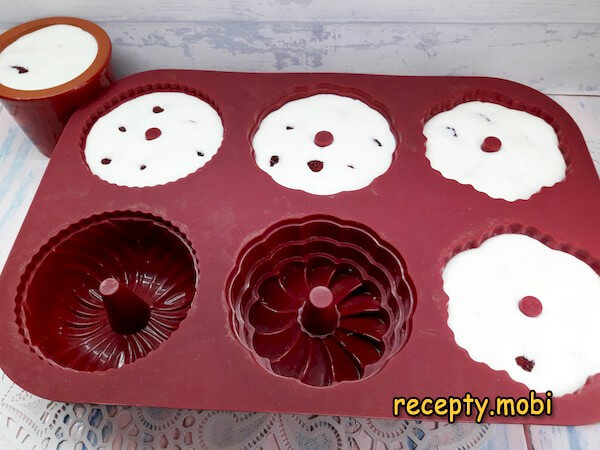
I add raspberries and use a spoon to help them sink into the middle of the cottage cheese mass, since a classic blancmange should not have pieces of filling sticking out.
I put the moulds in the fridge. After 2 hours they can safely be taken out.
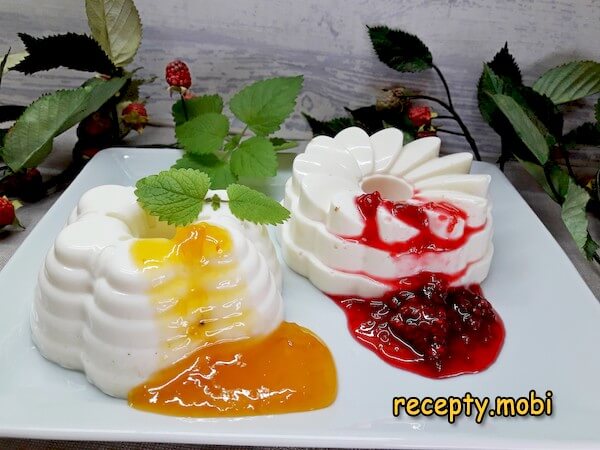
When serving cottage cheese blancmange, I decorate it with berries and mint leaves. You can drizzle the dish with sour cream, jam, or honey. The delicate, smooth and stable texture is clearly visible in the outer relief of the portions, while in cross-section the raspberries show up colourfully. The portions that were dipped in boiling water in their cups have walls that are not quite as smooth, but this does not spoil them in the least.


Tips
- 1
Cottage cheese in packs is the "secret" to smoothness. Paste-like cottage cheese does not need to be rubbed through. Grainy cottage cheese must be sieved.
- 2
20 g of gelatin is the "secret" to the shape. Less and it will not set. More and it will be "rubbery". Exactly 20 g.
- 3
Vanillin instead of sugar is the "secret" to smoothness. Sugar granules spoil the silky texture. Only powdered sugar or vanillin.
- 4
Cooling the milk with gelatin is the "secret" to uniformity. Hot mixture into the cottage cheese will curdle it. Only room temperature. The same principle works in other kinds of cottage cheese desserts.
FAQ
Which cottage cheese should I choose? +
Ideally, fresh paste-like cottage cheese of 5–9% fat (with no grains). Alternatives: grainy cottage cheese (360 g – rub it through a sieve), soft cottage cheese in tubs such as "Prostokvashino" or "Activia cottage cheese" (360 g – a "premium" option), mascarpone (360 g – an Italian accent). The brands "Prostokvashino", "Domik v Derevne", "President" and "B. Yu. Alexandrov" are tried and tested. Do not use: fat-free 0% (the blancmange will be "watery") or dry grainy cottage cheese without whey. For a "premium" version, use farmhouse country cottage cheese. For a "diet" version, 5% fat. For a "children's" version, soft paste-like 9%.
What can replace the gelatin? +
Alternatives: agar-agar (8 g – vegan, firmer), pectin (15 g – with a fruity note), leaf gelatin (20 g = 8 sheets – "premium", clearer), "instant" gelatin (20 g – no soaking). The brands "Dr. Oetker", "Gala Estet" and "Bekro" are tried and tested. Fresh gelatin (no more than 1 year old) is the "premium" option. Do not use: expired gelatin (it will not set) or fine "decollated" gelatin (it dissolves less well). For the "classic" version, ordinary edible gelatin, 20 g. For the "premium" version, soak leaf gelatin in cold water for 5 minutes.
How long does the blancmange keep? +
In the fridge, in the moulds under cling film, 3 days. Any longer and the gelatin may "run" and the berries may spread. Before serving, chill for 2 hours in the fridge until fully stabilised. I do not recommend the freezer, as the gelatin structure will separate. For a "premium" presentation, decorate with berries and mint 5 minutes before serving. Fresh blancmange is at its "star" best 2–3 hours after setting. On the second day the flavour is deeper and brighter. Do not leave it at room temperature for longer than 30 minutes, as the gelatin will start to melt.
What to serve the blancmange with? +
A classic for the dessert table: with fresh berries (raspberries, strawberries, blueberries). With berry syrup or jam. With honey and nuts. With chocolate sauce. With vanilla ice cream – unusual. With a cup of coffee with milk. With green or herbal tea. With a glass of sweet dessert wine (Sauternes, Riesling Eiswein). With a liqueur (Baileys, Amaretto). For a "date", with champagne and chocolates. With a fruit salad – a "light" dessert. With a cup of cocoa – a "children's" version. A versatile light dessert for dinner parties.
- Comment
or post as a guest
Be the first to comment.