What is gelatin made of
Gelatin is made from collagen, the structural protein found in the bones, skin, cartilage, and connective tissue of animals – most commonly pigs and cattle. During manufacturing, the raw materials are treated with acid or alkali and then slowly boiled to extract the collagen, which is dried into the odourless, flavourless powder or sheets you find in the shop. Understanding what goes into this pantry staple matters whether you are simply a curious cook or someone navigating dietary restrictions, from the difference between Type A and Type B gelatin to its nutritional profile and the best plant-based substitutes for anyone avoiding animal-derived products.
Not everyone knows what gelatin is made of, even though its use in the food industry is a long-established practice. For this reason, debates often arise about whether it is good or bad for the human body. I have gathered the key facts about the composition, types, and production of gelatin in order to dispel the myths.
There is food gelatin and technical gelatin.
Food gelatin is used not only in cooking but also in pharmacology and cosmetology as a thickener.
Technical gelatin is used in the production of paint, photographic and cinema film, photographic paper, and in the paper industry as a glue for high-grade paper.
What is gelatin, what is it made of
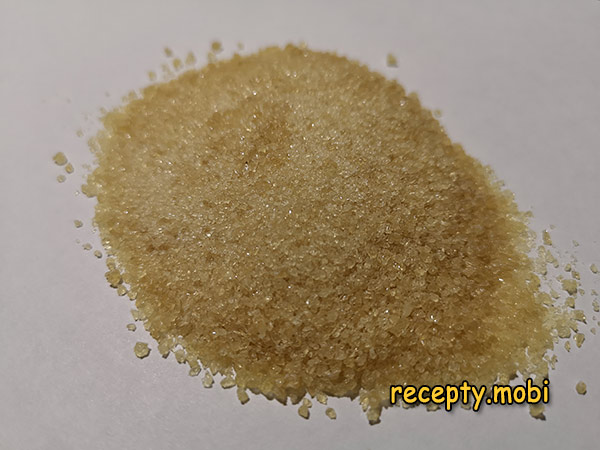
Gelatin is partially hydrolysed collagen protein in the form of a translucent substance, often with a yellowish tint. In the presence of moisture it swells, forming a jelly-like, viscous mass. Food gelatin goes on sale as small granules, as a powder, or in sheets.
Along with collagen, gelatin also contains important amino acids that are necessary for the normal functioning of cartilage and connective tissue.
A quality product has a balanced composition. 100 grams of the substance contains:
- protein – 87.2 g;
- carbohydrates – 0.7 g;
- fats – 0.4 g;
- phosphorus – 300 mg;
- starch – 0.7 g;
- potassium – 1.2 mg;
- magnesium – 80 mg;
- calcium – 700 mg;
- ash – 1.7 g;
- iron – 2000 μg;
- sodium – 11 mg.
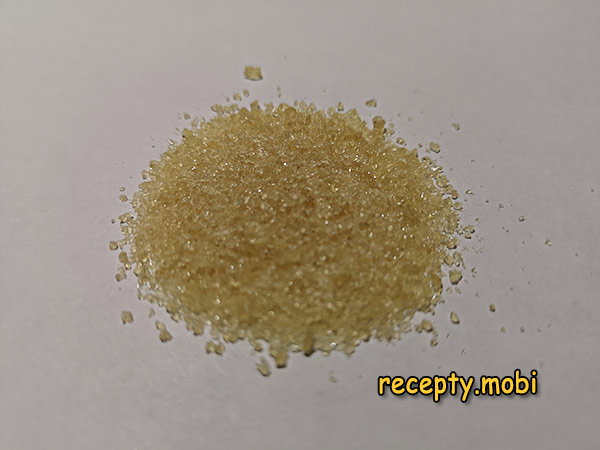
Production of gelatin
Gelatin is made by partially hydrolysing collagen from cartilage, tendons, bones, skin, and even hooves, as well as from fish bones, gills, and scales.
Some manufacturers process only bones and cartilage, while others use hides and tendons. From fish raw materials, mainly the scales are used.
Fish gelatin is found less often on sale, because its production is considerably more complex than that of meat gelatin. It dissolves more slowly in water, so it needs to be soaked for longer. But for jellied pike perch this kind of gelatin is ideally suited.
How gelatin is made
The raw material undergoes preliminary veterinary and sanitary inspection, is sorted by type, and is crushed. Then it goes through preliminary preparation. This is done in order to clean the collagen of the "ballast" proteins that worsen the quality of the product. There are two methods of preliminary preparation – alkaline processing and acid processing.
- Group A is the gelatin obtained after acid treatment. Pig skins are subjected to it.
- Group B gelatin is obtained after alkaline treatment of raw materials from cattle.
In both cases the gelling properties turn out to be the same, but Group A gelatin has a lower viscosity.
The prepared raw material is subjected to prolonged boiling in cooking furnaces, where the extraction takes place. During this time the collagen is converted into gelatin.
The resulting gelatin solution is purified of various impurities, filtered free of water, sterilised at a temperature of 130–140 degrees, and dried off with filtered dry air.
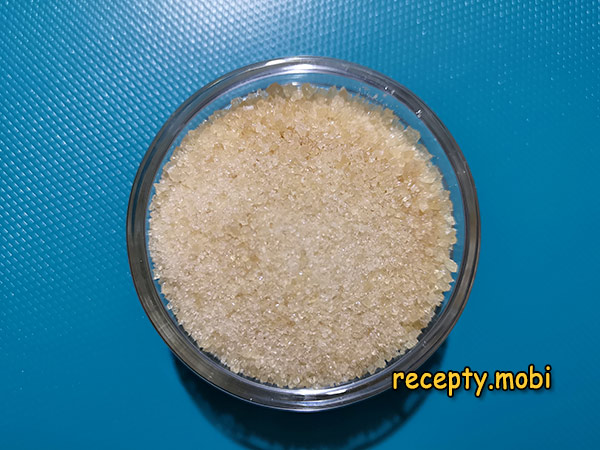
Which gelatin is better
It is impossible to say with certainty which gelatin is better – powdered or sheet. In production, most cooks prefer to use powdered gelatin, because it can be dissolved into a gelatin mass in advance, kept in the fridge, and used as needed. It is dissolved in room-temperature water at a ratio of 1 gram of gelatin per 5–6 grams of water. The proportions must be observed strictly, otherwise the mass will not reach the right consistency.
Sheet gelatin absorbs only the amount of moisture it needs, and it should be soaked in cold water. You can simply place it in a container of water and squeeze out the excess liquid before use.
Which gelatin is better to use – sheet or powdered – makes little difference. They are interchangeable. What you need to pay attention to is its gelling ability, in other words the strength of the gelatin. It is measured on the Bloom system, and most varieties of gelatin have 50–300 Bloom. The most common of them are 180 and 200 Bloom. These are usually the parameters assumed in recipes, and the gel strength is not stated.
The higher the Bloom rating, the faster the gelatin sets and the stronger the resulting gel.
In short about the important
- The dissolved gelatin should be poured into a warm component, so that it has time to distribute, does not set too early, and does not turn into a lump.
- Sheet gelatin is lowered into cold water carefully, one sheet at a time, so that the sheets do not stick together.
- Quality gelatin can, in principle, withstand boiling, but if you are not sure of its quality, it is better not to take the risk and not to heat any liquid that already has gelatin added to it above 80 degrees.
❓ Frequently asked questions
What raw materials is food gelatin produced from?
Food gelatin is made from collagen of animal origin – the cartilage, tendons, bones, skin, and hooves of cattle and pigs. Fish gelatin is also produced, from the bones, gills, and scales. By the type of raw-material processing, two kinds are distinguished: Group A (acid treatment of pig skins) and Group B (alkaline treatment of raw materials from cattle). There is also a plant-based analogue – agar agar (from seaweed) and pectin (from fruit), but this is not gelatin in the strict sense.
How does powdered gelatin differ from sheet gelatin?
Powdered gelatin is soaked in room-temperature water in a strict proportion of 1 g of gelatin per 5–6 g of water. It is convenient to measure out and can be prepared in advance. Sheet gelatin is soaked in cold water – the sheets absorb as much moisture as they need, and the excess is squeezed out before use. In terms of gelling properties they are interchangeable. In production, powdered gelatin is chosen more often, since it can be prepared ahead of time. In the home kitchen, people usually use whatever is at hand. The main thing is to be guided by the Bloom strength (180–200 for most recipes).
What is the Bloom strength of gelatin and why is it needed?
The Bloom strength is a measure of the gelling ability of gelatin, measured on a special system. Different varieties have 50–300 Bloom, the most common being 180 and 200. The higher the Bloom, the faster the gelatin sets and the stronger the resulting gel. In most recipes the manufacturer does not state the Bloom separately – the standard 180–200 is assumed. If you use gelatin with a different Bloom, the dosage will have to be adjusted. Professional pastry chefs often work with a specific Bloom for a precise result.
Can you boil liquid with gelatin?
Quality gelatin can, in principle, withstand boiling, but it is risky – some of the gelling properties may be lost. If you are not sure of the quality of your gelatin, it is better not to heat the liquid with it above 80 degrees. The dissolved gelatin should be poured into a warm component (not hot and not cold) – then it will distribute evenly without lumps. The ideal mixing temperature is 40–60 degrees. Remember: when gelatin is added to acidic ingredients (citrus juices, pineapple), the gelling strength decreases – boil the fruit juice before adding it.