avg —
How to properly cook cornmeal – the simplest methods

Instructions
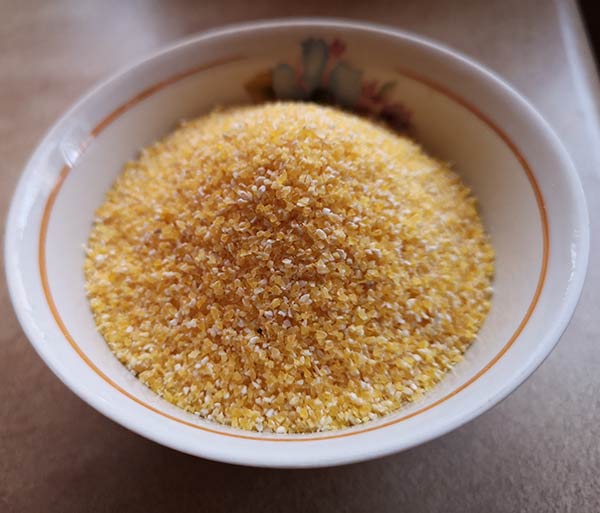
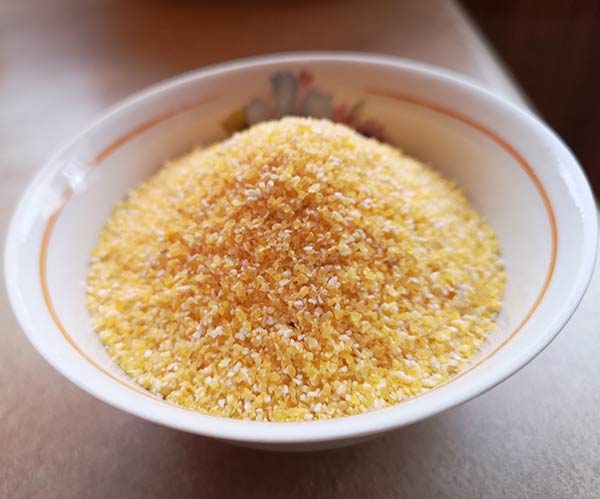
I rinse the cornmeal several times in cold water until the water runs completely clear. Rinsing removes the surface dust and starch, which makes the porridge more uniform and cleaner in taste. Use a fine sieve so you do not lose the grain along with the water while rinsing.
I bring the water to a rolling boil in a heavy-bottomed pan of at least 3 litres. Cornmeal swells to 3–4 times its volume during cooking, so a roomy pan is essential. A thick base is also critical: a thin one will guarantee scorching as it cooks.
I add the rinsed grain and the salt to the boiling water in a thin stream, stirring constantly, just as when making semolina porridge. The “whirlpool” technique, stirring in the centre, helps to avoid the lumps that cornmeal is so prone to forming.
Once it comes back to the boil, I turn the heat down to its lowest setting and cover with the lid left slightly ajar to let the steam escape. A fully closed lid can make the porridge boil over the edge – a slightly open lid solves this and lets you keep an eye on the process.
I cook it for 30 minutes over the lowest heat, stirring every 5 minutes with a long wooden spoon. Regular stirring is the main secret to keeping the porridge from catching on the bottom. Watch the last 10 minutes especially closely – by then the grain has thickened a great deal and is at its most likely to scorch.
I add the butter and stir thoroughly until it has fully melted. The butter gives the porridge a soft, creamy taste and a lovely sheen. You can use clarified butter or olive oil instead – each gives its own character. For a sweet version, honey also works, in place of or alongside the butter.
I take it off the heat and leave it covered for 15 minutes to settle and thicken. In this time the porridge finishes cooking and takes on its characteristic dense, polenta-like texture. Without this pause the porridge stays a little runny; once rested, it turns out perfect.
The corn porridge is ready! I serve it warm with fruit (bananas, apples, pears), berries (raspberries, blueberries), honey, or maple syrup, as a sweet breakfast. In the Italian style I serve it as a “polenta” side dish with fried meat, grated Parmesan, and olive oil.


Tips
- 1
Use a heavy-bottomed pan and the porridge will not catch. A thin aluminium base will give the whole dish a scorched taste.
- 2
Keep to the ratios: 1:3 for a thick, dense porridge (polenta), 1:5 for a runny milky one with fruit.
- 3
Finely ground cornmeal cooks in 20 minutes; a coarse grind needs 30–40 minutes. I make Moldavian mamaliga on a similar principle.
- 4
Cornmeal contains no gluten – an excellent alternative for children’s and dietary meals in cases of wheat intolerance.
FAQ
Why does corn porridge catch on the bottom of the pan? +
The main causes are: a thin pan base (aluminium or thin-walled enamelled cookware), stirring too rarely while it cooks (cornmeal is extremely prone to catching), and heat that is too high. Use only heavy-bottomed pans – preferably cast iron or stainless steel with a multi-layer base. Stir every 5 minutes throughout the cooking time and do not leave the porridge to fend for itself. In the last 10 minutes stir even more often – every 2–3 minutes.
How long do you cook cornmeal of different grinds? +
The cooking time depends heavily on the grind: a fine grind (like semolina) – 20 minutes; a medium grind (the standard for porridge) – 30 minutes; a coarse grind (polenta) – 40–50 minutes. There is also an “instant” corn couscous, which is ready in 5 minutes by steeping in boiling water. The grind is usually stated on the packaging. For children’s meals choose a fine or medium grind, and for Italian polenta a coarse one. Each gives its own texture.
Can you cook corn porridge with milk? +
Yes, replace some of the water with milk for a softer taste – this is the classic version for a children’s breakfast. The ratio is half water plus half milk, or milk alone for the richest version. With pure milk, cook it longer and watch more carefully for scorching, as milk catches faster than water. Halve the salt. Add 1–2 tablespoons of sugar, or honey at the end of cooking. It is especially good with pumpkin or apple – a classic of children’s cooking.
How is corn porridge good for you, and who is it suited to? +
Corn porridge contains no gluten – ideal for people with a gluten intolerance, coeliac disease, or a wheat allergy. It is rich in carotene, B vitamins, magnesium, iron, and fibre. It supports the heart and the nervous system and is good for digestive problems. It is suitable for children’s meals from 6–8 months as a first weaning porridge. It is also recommended on a diet – low in calories, filling, and good for the gut. In Italy it is considered a traditional “peasant” food for stamina.
- Comment
or post as a guest
Be the first to comment.