How to dilute 70% acetic acid to 9% vinegar, 6% and 3%
Diluting 70% vinegar essence down to 9%, 6% or 3% is a common task when making pickles, marinades or canned preserves at home. Getting the right concentration matters both for food safety and for achieving the proper flavour. In this guide you will find an easy-to-use dilution chart showing exactly how much water to add per spoon or millilitre of vinegar essence. We also explain the simple formula so you can work out any concentration yourself. The whole process takes just a couple of minutes and needs no special equipment, only a spoon, some water, and a little caution when handling concentrated acetic acid.
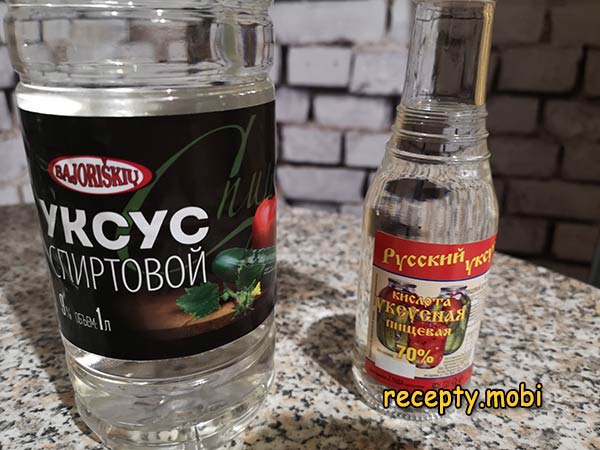
I am forever diluting vinegar essence, because culinary recipes call for acetic acid in all sorts of concentrations: 70%, 9%, 6%, and even one percent. It is unlikely that any cook keeps bottles of every solution on the kitchen shelf, but if you have the essence and know the proportions, it is easy to make up whatever strength you need at home. Essence is the name for a concentrated aqueous solution of acetic acid, around 70–80%. Table vinegar, on average, contains 3–15% acid.
The difference in density between vinegar (1.0 g/cm³) and water (1.05 g/cm³) is so slight that their mass is treated as identical. For that reason both the essence and its water solution are calculated the same way by mass. You can also put an equals sign between the volume of the liquid and its weight, so it makes no difference whether a recipe gives grams or millilitres.
How to dilute vinegar properly
First work out the amount of water and vinegar you need using the schemes below. The mixing itself is very simple: into a clean container pour the required amount of filtered or cooled boiled water first, and only then carefully add the vinegar. Stir. Do not use metal containers for dilution.
How many millilitres of vinegar in a spoon
Spoons made in the USSR hold 15 ml of vinegar. Under the current standard GOST 32583-2013 a tablespoon should hold 15 ± 2 ml, though spoons of 18 ml are also sold. If the spoon was made abroad, it may well hold 20 ml.
A dessert spoon holds 10 ± 2 ml.
A teaspoon holds 5 ± 1 ml.
A coffee spoon holds 3 ± 1 ml.
How many grams of vinegar in a spoon
Just as with millilitres, the weight of concentrated 70% essence and of table vinegar is:
- in a tablespoon – 15 grams;
- in a dessert spoon – 10 grams;
- in a teaspoon – 5 grams;
- in a coffee spoon – 3 grams.
How to measure vinegar with a spoon
Given that tablespoons of 15 ml are the most common, working out the amount of liquid you need is not difficult.
- 10 ml of vinegar is 2/3 of a tablespoon.
- 20 ml is 1 tbsp + 1 tsp.
- 25 ml is 1 tbsp + 2 tsp.
- 30 ml is 2 tbsp.
- 40 ml is 2 tbsp + 2 tsp.
- 50 ml is 3 tbsp + 1 tsp.
- 60 ml is 4 tbsp.
- 70 ml is 4 tbsp + 2 tsp.
- 80 ml is 5 tbsp + 1 tsp.
- 90 ml is 6 tbsp.
- 100 ml is 6 tbsp + 2 tsp.
Since the volume of tablespoons varies, for convenience I offer two sets of calculations for obtaining 9% table vinegar from concentrated 70% essence.
Concentrated 70% acetic essence | Drinking water |
1 tbsp holding 15 ml | 7 tbsp or 21 tsp |
1 tbsp holding 20 ml | 7 tbsp or 28 tsp |
How to dilute 70% vinegar to 9% – table
To obtain 9% vinegar from 70% vinegar, add 1 part concentrated vinegar to 7 parts drinking water.
Example: to obtain 240 ml of 9% table vinegar, measure out 210 ml of water and add 30 ml of 70% vinegar to it. That is, with a 30 ml measuring glass you measure the water 7 times (giving 210 ml) and the vinegar once (30 ml).
70% vinegar | Water |
10 grams | 70 grams |
20 grams | 140 grams |
50 grams | 350 grams |
100 grams | 700 grams |
Calculating proportions for different concentrations
To obtain table vinegar solutions of different concentrations, dilute the 70% essence with water as follows:
Solution concentration | Drinking water | 70% vinegar |
30% | 1.5 parts | 1 part |
10% | 6 parts | 1 part |
9% | 7 parts | 1 part |
8% | 8 parts | 1 part |
7% | 9 parts | 1 part |
6% | 11 parts | 1 part |
5% | 13 parts | 1 part |
4% | 17 parts | 1 part |
3% | 22.5 parts | 1 part |
How to dilute vinegar by formula
This method gives the most accurate result, but it suits those who enjoy a bit of arithmetic.
The percentage concentration is worked out with a simple formula: W = K × Y : Z
The values in the formula:
W – the value sought (the amount of essence needed for dilution).
K – the amount of solution you want to obtain.
Y – the concentration of acid you want to obtain (9%, 6%, 3%, and so on).
Z – the concentration of the essence you have (70%, 80%).
Example calculation: you need to obtain 100 g of 9% table vinegar, and you have 70% essence on hand. Multiply the required volume (100 ml) by the required concentration (9%) and divide by the concentration of acid you have (70%).
100 × 9 : 70 = 12.8
So you need to take 12.8 ml of vinegar essence and enough water to bring the total volume to 100 ml. Working it out: 100 – 12.8 = 87.2. By precise calculation, then, to obtain 100 ml of 9% vinegar you mix 12.8 ml (rounded to 13 ml) of 70% vinegar essence with 87.2 ml (rounded to 87 ml) of drinking water.
Safety precautions
Observe basic safety precautions. When working with the essence, avoid getting the liquid on your skin or in your eyes – it can cause a chemical burn. If the concentrate gets on your skin, rinse it off at once with plenty of running water for 10 minutes. Then treat the area with baking soda or soap and rinse again.
Store the solution tightly closed and out of the reach of children.
❓ Frequently asked questions
Can apple cider vinegar replace vinegar essence?
In some recipes, yes, but with reservations. Apple cider vinegar is usually 5–6%, which is 12–14 times weaker than the essence. For marinades and salads the swap works. For preserving (canning vegetables) take more care, as apple cider vinegar is a weaker preservative: increase the amount by 1.5 times compared with 9% table vinegar. In baking (for slaking soda), 1 tsp of apple cider vinegar = 1/2 tsp of 9% table vinegar. Do not use apple cider vinegar in recipes with a high sugar content, as it may begin to ferment.
How do the different kinds of vinegar differ?
White table (spirit) vinegar is the most neutral, for preserving and marinades. Apple cider has a fruity note, for salads and sauces. Wine vinegar (white or red) belongs to European cuisine, for salads and meat. Rice vinegar is for Asian cuisine, for sushi and salads. Balsamic is sweet-and-sour, for dressings and caramelising. Malt vinegar belongs to English cooking, for fish and chips. The choice depends on the recipe: in some, vinegar is interchangeable, while others call for a specific kind. For Russian preserving, only white table vinegar.
How long does diluted vinegar keep?
Table vinegar at 3–9% in a glass bottle with a tight lid keeps for up to 2 years. Concentrated 70% essence keeps for up to 5 years. Once opened, the same periods apply provided the conditions are met: a dark, cool place and a tightly closed lid. Do not store it in plastic, as over time the plastic releases microparticles into the vinegar. The right choice is glass bottles with a silicone or metal lid. During storage the vinegar may turn cloudy or form a sediment – this is normal (the product is natural); strain it through cheesecloth if necessary.
What to do if you have made the solution too strong?
Simply dilute it with water to the required concentration. The formula: if you have 100 ml of 12% vinegar and need 9%, add 33 ml of water (133 ml in total). To simplify, the proportion is: (starting concentration / required concentration − 1) × volume. In the example: (12/9 − 1) × 100 = 33 ml. Do not add essence to a weak solution, as you will get an uneven mixture. Always go "from strong to weak" – that is, dilute with water rather than adding essence.